
Castagna
The Castagna coachbuilding tradition dates to nineteenth-century Milan, when Carlo Castagna took over an established carriage business. Carrozzeria Castagna later became renowned for luxury bespoke automotive bodies.
Explore record ↗
1929Coachwork by Castagna
THE VEHICLE AT A GLANCE
THE PEOPLE BEHIND THE CAR
The Castagna coachbuilding tradition dates to nineteenth-century Milan, when Carlo Castagna took over an established carriage business. Carrozzeria Castagna later became renowned for luxury bespoke automotive bodies.
Explore record ↗01 / THE STORY
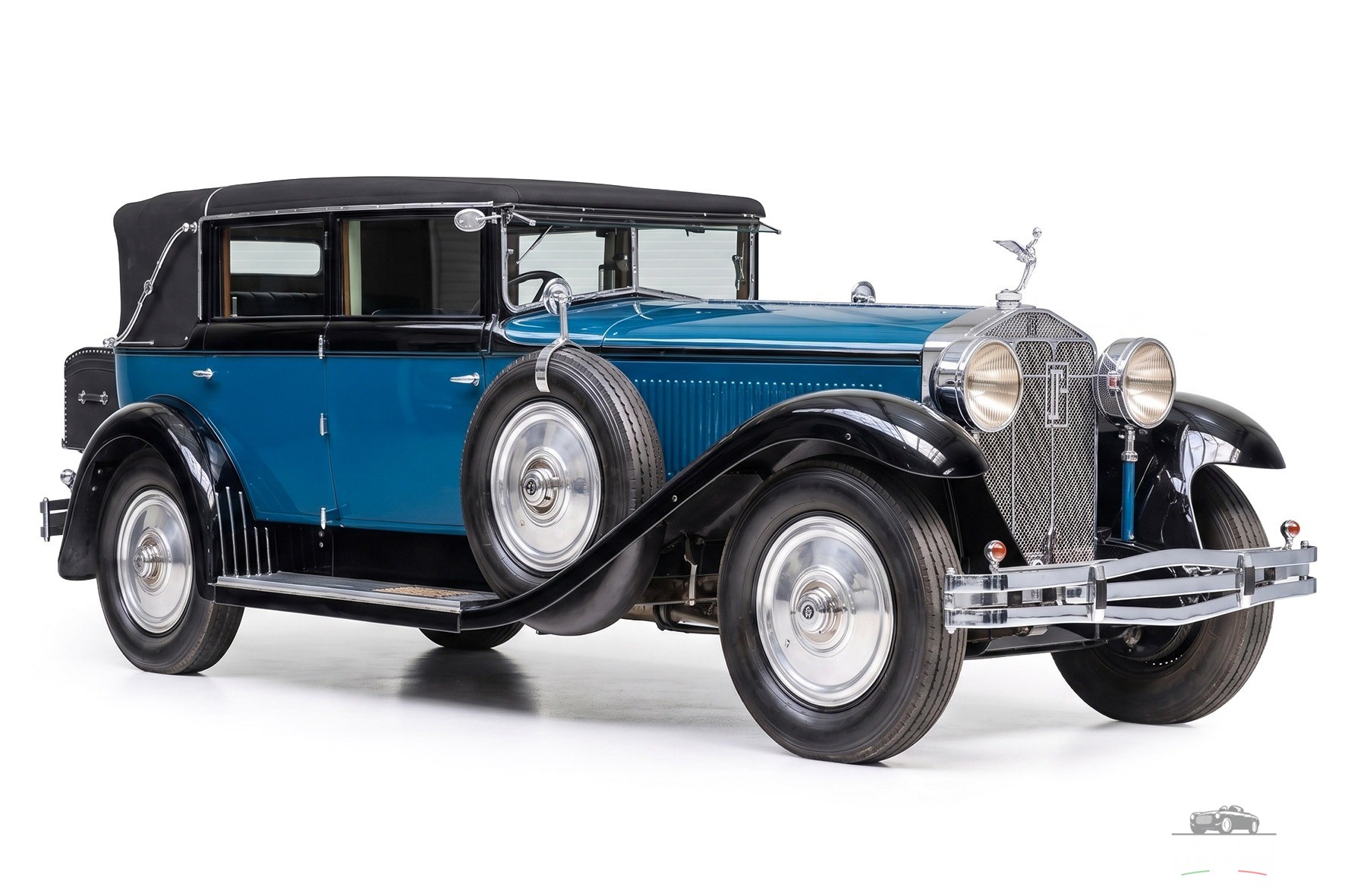
The Isotta Fraschini Tipo 8A bodied by Carrozzeria Castagna dates from 1929 and belongs to the final phase of production of Isotta Fraschini’s flagship chassis. Introduced in 1924, the Tipo 8A was supplied exclusively as a rolling chassis to be completed by independent coachbuilders for private clients. Castagna, based in Milan, was among the firms most frequently selected for formal and ceremonial bodies on Isotta Fraschini chassis during the 1920s. The Tipo 8A was powered by a 7,370 cc inline eight-cylinder engine with overhead valves and an aluminium crankcase. The engine was configured for smooth and quiet operation, with twin carburettors and output generally ranging between 115 and 160 horsepower, depending on specification. Power was transmitted through a three-speed manual gearbox to a live rear axle. The chassis incorporated four-wheel servo-assisted mechanical drum brakes, semi-elliptic leaf springs at both axles, and a long wheelbase suitable for large luxury bodies. Suspension and braking were engineered to provide stability and comfort during sustained high-speed touring. Castagna’s coachwork for the Tipo 8A was executed in landaulet form. This body type featured a fixed forward roof section with a folding rear roof, allowing rear passengers to travel either fully enclosed or partially open. The configuration was widely used for official, diplomatic, and high-status private use. Construction followed traditional coachbuilding practice, employing a wooden frame covered with hand-formed metal panels. Panel shaping, fit, and surface finish were executed to a high standard, consistent with Castagna’s reputation. The exterior design emphasized formal proportions, with a long bonnet, upright radiator grille, flowing fenders, and restrained use of chrome trim. The open rear section was integrated into the overall body structure without altering the visual balance of the car. Interior appointments were customized according to client requirements and typically included fine upholstery and wood trim. Exact production numbers for Castagna-bodied Tipo 8A landaulets are not documented, but such bodies were produced in very limited quantities. Surviving examples are recorded in private collections and archival sources and provide reference material for the study of late-1920s Italian luxury coachbuilding and Isotta Fraschini’s highest-level production.
02 / TECHNICAL IDENTITY
03 / DESIGN, BODY & SUPPLIERS
Coachbuilder / Design studio
The Castagna coachbuilding tradition dates to nineteenth-century Milan, when Carlo Castagna took over an established carriage business. Carrozzeria Castagna later became renowned for luxury bespoke automotive bodies.
Explore record ↗07 / GALLERY
THE CONVERSATION
Comments 0