
Pininfarina
Founded by Battista Pinin Farina in Turin in 1930, Pininfarina became one of the most influential Italian styling and coachbuilding houses, particularly through its work for Ferrari and other international manufacturers.
Explore record ↗
1932Coachwork by Pininfarina
THE VEHICLE AT A GLANCE
THE PEOPLE BEHIND THE CAR
Founded by Battista Pinin Farina in Turin in 1930, Pininfarina became one of the most influential Italian styling and coachbuilding houses, particularly through its work for Ferrari and other international manufacturers.
Explore record ↗01 / THE STORY
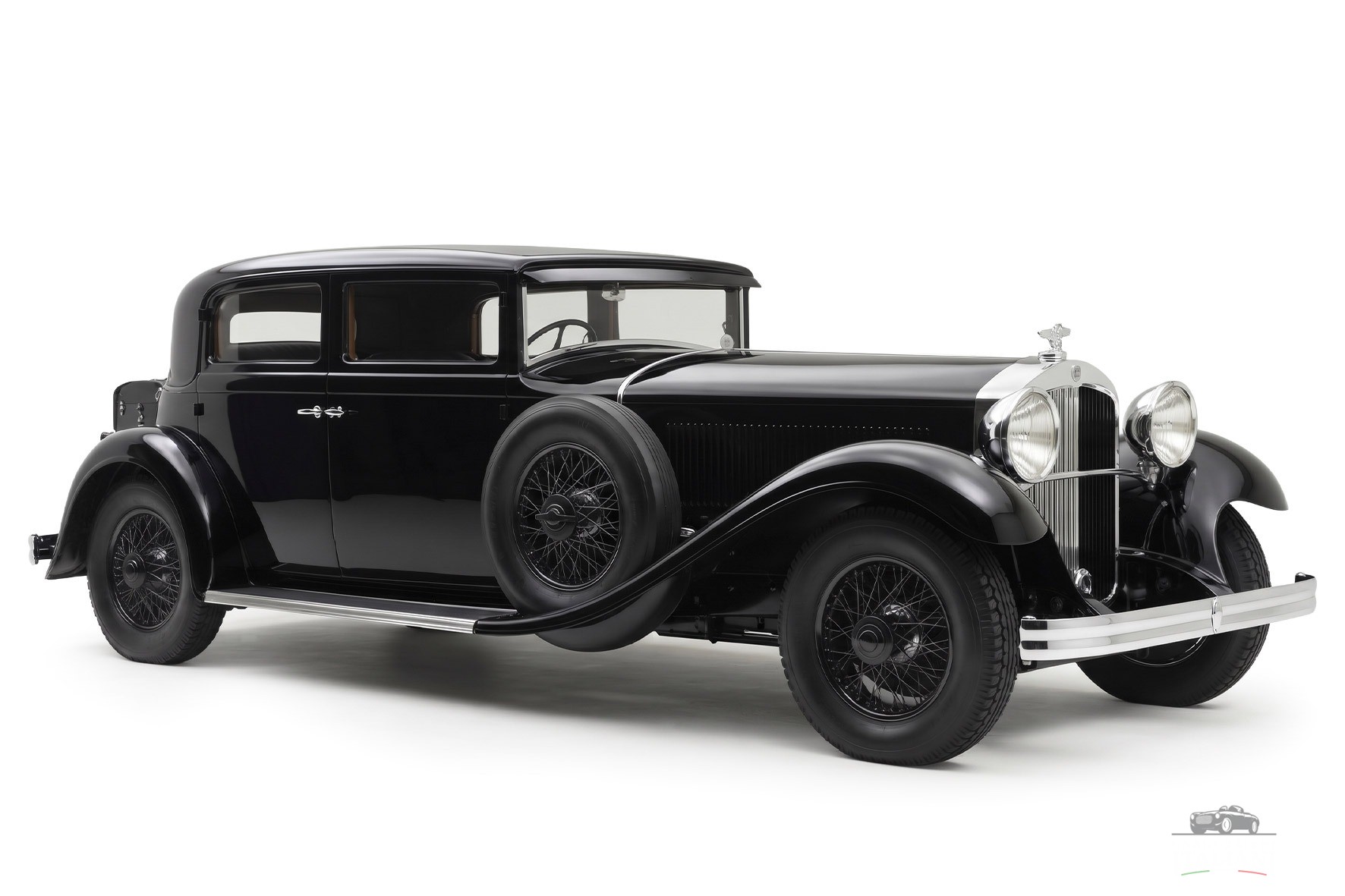
The Isotta Fraschini Tipo 8A, completed in 1932 with coachwork by Pininfarina, represents one of the later bespoke executions of Isotta Fraschini’s flagship chassis during the final phase of its production. Introduced in 1924, the Tipo 8A was supplied exclusively as a rolling chassis and bodied to order by leading coachbuilders for a clientele drawn from aristocratic, diplomatic, and industrial circles. The Tipo 8A chassis was powered by a 7,370 cc inline eight-cylinder engine with overhead valves and an aluminium crankcase. The engine was designed for smoothness, mechanical refinement, and sustained high-speed touring rather than outright performance, with output generally quoted between 115 and 160 horsepower depending on specification. Power was transmitted through a three-speed manual gearbox to a live rear axle. The chassis incorporated four-wheel servo-assisted mechanical drum brakes, semi-elliptic leaf springs at both axles, and a long wheelbase suited to large luxury bodies. Suspension tuning prioritized ride comfort and stability, consistent with the expectations of the high-end market. Pininfarina’s coachwork for the Tipo 8A reflected the stylistic transition of the early 1930s, moving away from heavily formal bodies toward more streamlined and visually coherent forms. The design emphasized balanced proportions, controlled surface transitions, and restrained ornamentation. Construction followed traditional coachbuilding practice, employing a wooden frame covered by hand-formed metal panels. Attention was given to glazing, roofline continuity, and the integration of fenders with the main body volume, aligning with contemporary aerodynamic sensibilities without adopting overtly experimental solutions. The interior was executed to individual client specifications, typically combining fine upholstery, wood veneers, and discreet metal fittings. Layout favored passenger comfort and ease of access, consistent with the Tipo 8A’s role as a long-distance luxury automobile. Production of the Tipo 8A extended until 1931–1932, with approximately 950 chassis built in total. Only a small number received coachwork from Pininfarina, each differing in detail according to commission.
02 / TECHNICAL IDENTITY
03 / DESIGN, BODY & SUPPLIERS
Coachbuilder / Design studio
Founded by Battista Pinin Farina in Turin in 1930, Pininfarina became one of the most influential Italian styling and coachbuilding houses, particularly through its work for Ferrari and other international manufacturers.
Explore record ↗07 / GALLERY
THE CONVERSATION
Comments 0