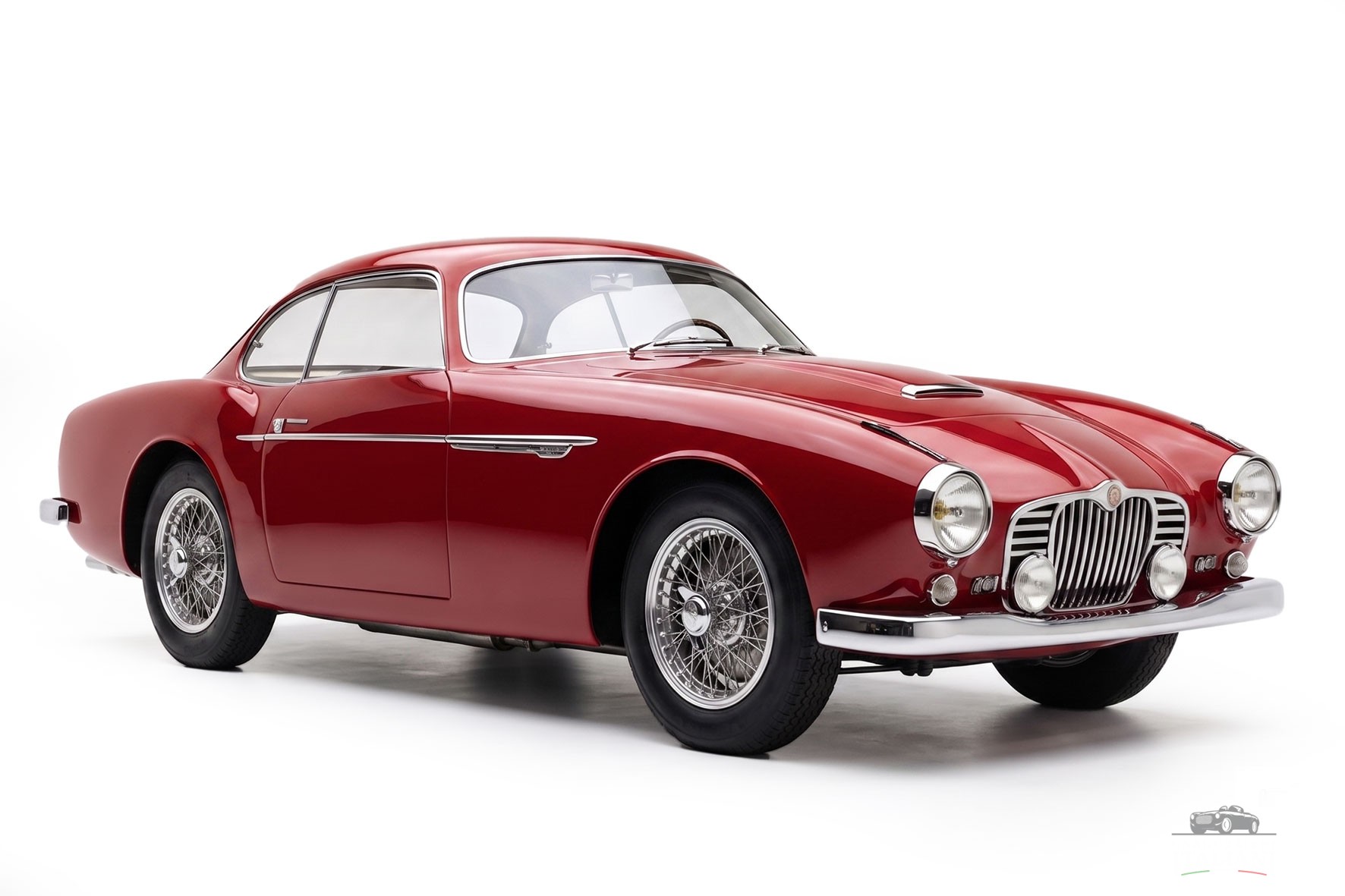

Zagato
Founded in Milan in 1919 by Ugo Zagato, the coachbuilding house developed lightweight aerodynamic bodies inspired by aircraft construction, creating distinctive racing and grand touring automobiles.
Explore record ↗
1958Coachwork by Zagato
THE VEHICLE AT A GLANCE
THE PEOPLE BEHIND THE CAR
Founded in Milan in 1919 by Ugo Zagato, the coachbuilding house developed lightweight aerodynamic bodies inspired by aircraft construction, creating distinctive racing and grand touring automobiles.
Explore record ↗01 / THE STORY
The Jaguar XK150 GTZ was a coachbuilt coupé produced by Zagato on the Jaguar XK150 Special Equipment chassis. Chassis S834369 was assembled as a rolling chassis at Jaguar’s Browns Lane works in August 1957 for a Jaguar dealer in Geneva, who commissioned the Milanese coachbuilder to design and construct an aluminium body. The body was supported by a tubular steel framework, with hand-formed aluminium exterior panels. Alterations made for the coachwork included extensions to the upper front shock-absorber towers and body-support brackets. No individual designer has been conclusively identified for this commission.
The completed S834369 was exhibited on the Zagato stand at the Geneva Motor Show in March 1958. It was later confused in some historical accounts with another Zagato-bodied XK150 associated with 1960. The two cars differed in their frontal treatment and bumper arrangements. The earlier Zagato-bodied Jaguar XK140, shown in 1957, was a separate vehicle. The available evidence supports a total of two XK150 Zagato coupés, although the precise factory production register and the chassis number of the second example have not been established. The later XK150 GTZ has been associated with the 1960 Paris Motor Show, but that appearance cannot be attributed to S834369.
S834369 was based on the XK150 SE specification. The contemporary 3.4-litre XK150 SE used a 3,442 cc double-overhead-camshaft inline-six, with a nominal output of 210 SAE gross bhp, a four-speed transmission and rear-wheel drive. These are the standard mechanical figures for the donor specification rather than independently measured performance data for the Zagato-bodied car. Its original engine serial number, Zagato body number and precise completed-body dimensions are not established.
Chassis S834369 was taken to the United States in the early 1960s and was acquired in 1964 by the father of its later owner. The car remained associated with the same family during the subsequent restoration. Work documented from 2020 revealed extensive galvanic corrosion where aluminium panels met steel structural members. The original aluminium roof skin was retained, while sections of the door frames, sill structures, front and rear body panels, and supporting tubes required reconstruction. By August 2026, work on the front panels, door frames and bumper mountings was still in progress.
02 / TECHNICAL IDENTITY
Become a Pro member to see the full details in this section.
Membership is not available yet.
View membership optionsBecome a Pro member to see the full details in this section.
Membership is not available yet.
View membership options03 / DESIGN, BODY & SUPPLIERS
Coachbuilder / Design studio
Founded in Milan in 1919 by Ugo Zagato, the coachbuilding house developed lightweight aerodynamic bodies inspired by aircraft construction, creating distinctive racing and grand touring automobiles.
Explore record ↗04 / CHRONOLOGY
06 / CHASSIS REGISTER
07 / GALLERY
THE CONVERSATION
Comments 0