
Touring
Founded in Milan in 1926, Carrozzeria Touring became renowned for elegant grand touring bodies and its patented Superleggera lightweight construction method, later revived under new ownership.
Explore record ↗
1966Coachwork by Touring
THE VEHICLE AT A GLANCE
THE PEOPLE BEHIND THE CAR
Founded in Milan in 1926, Carrozzeria Touring became renowned for elegant grand touring bodies and its patented Superleggera lightweight construction method, later revived under new ownership.
Explore record ↗Federico Formenti was an Italian automotive stylist at Touring and Alfa Romeo, noted for his contributions to post-war coachbuilt grand tourers.
Explore record ↗01 / THE STORY
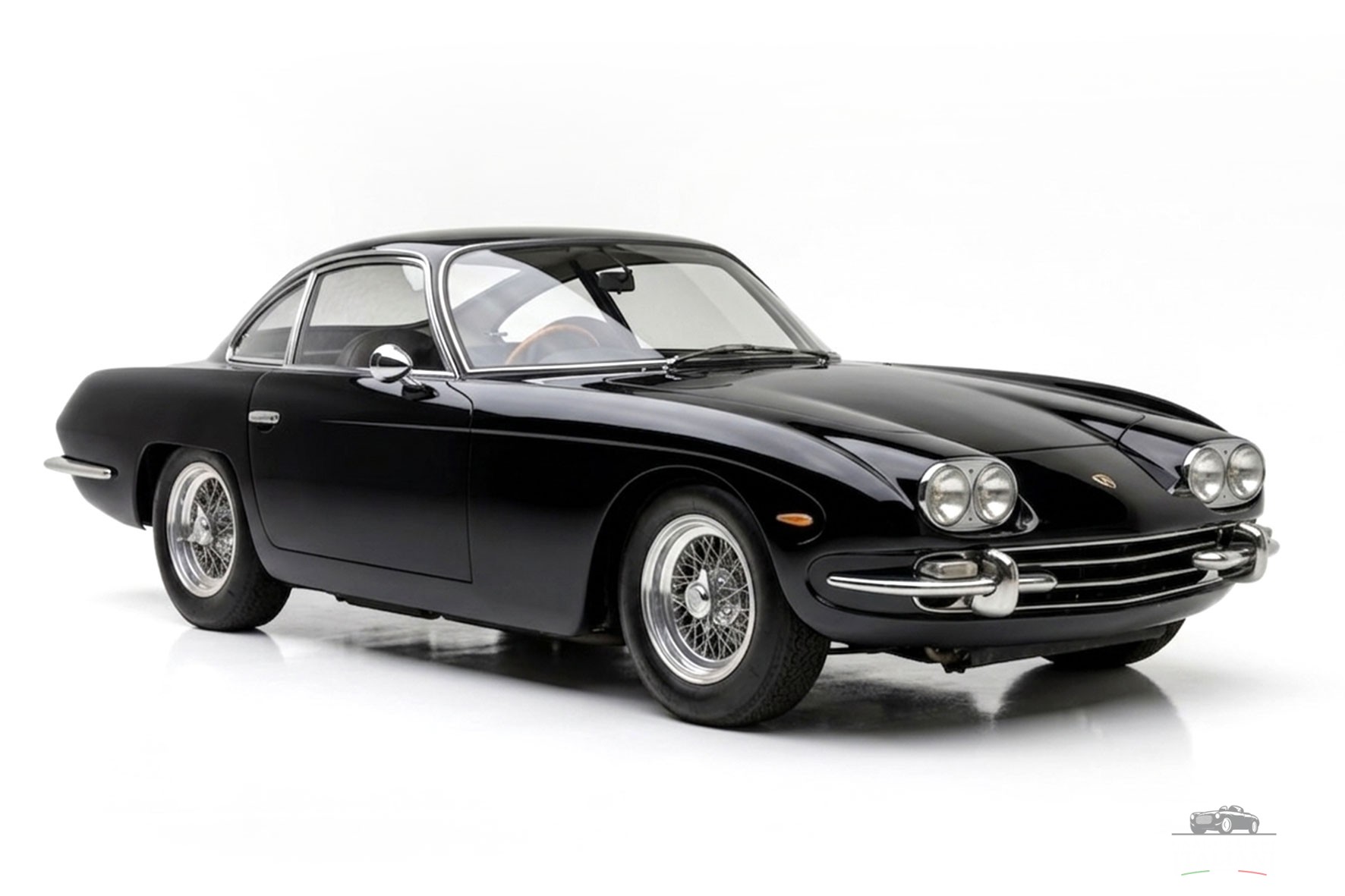
The Lamborghini 400 GT 2+2 was a grand touring automobile manufactured by Automobili Lamborghini between 1966 and 1968. It succeeded the earlier 350 GT and marked the company’s transition toward more mature and refined high-performance vehicles. Conceived to offer a balance between sports car dynamics and touring comfort, the 400 GT 2+2 contributed significantly to the early identity of the marque. The model was equipped with a naturally aspirated V12 engine designed by Giotto Bizzarrini. Displacing 3,929 cubic centimeters, the all-aluminum power unit featured dual overhead camshafts per cylinder bank and six twin-choke Weber carburetors. The engine produced approximately 320 horsepower at 6,500 revolutions per minute and was coupled to a five-speed manual gearbox developed in-house by Lamborghini. Power was transmitted to the rear wheels, allowing for acceleration from zero to one hundred kilometers per hour in under seven seconds and a maximum speed of approximately 250 kilometers per hour. The chassis employed a tubular steel structure with independent suspension at all four corners, utilizing double wishbones and coil springs. Disc brakes were fitted as standard. The wheelbase measured 2,550 millimeters, contributing to stable high-speed handling characteristics. The vehicle’s proportions and overall configuration supported its role as a long-distance performance automobile. Bodywork was executed by Carrozzeria Touring using steel panels, incorporating elements of Superleggera construction in earlier models. The 2+2 configuration necessitated modifications to the roofline and rear cabin area, resulting in a taller profile and reconfigured rear bodywork compared to the 350 GT. The design retained a restrained elegance, with minimal ornamentation and proportions favoring aerodynamic efficiency. The interior accommodated four occupants, though rear seating was limited in legroom and best suited for occasional use. The cabin was trimmed in leather with wood veneer detailing and included instrumentation specific to the model. Approximately 224 units of the 400 GT 2+2 were produced before the model was replaced by the Lamborghini Islero. The 400 GT 2+2 is regarded as a foundational model in Lamborghini’s early history, bridging the gap between bespoke sports car production and the emerging segment of Italian high-performance grand tourers.
02 / TECHNICAL IDENTITY
03 / DESIGN, BODY & SUPPLIERS
Coachbuilder / Design studio
Founded in Milan in 1926, Carrozzeria Touring became renowned for elegant grand touring bodies and its patented Superleggera lightweight construction method, later revived under new ownership.
Explore record ↗Designer
Federico Formenti was an Italian automotive stylist at Touring and Alfa Romeo, noted for his contributions to post-war coachbuilt grand tourers.
Explore record ↗04 / CHRONOLOGY
07 / GALLERY
THE CONVERSATION
Comments 0