
Pininfarina
Founded by Battista Pinin Farina in Turin in 1930, Pininfarina became one of the most influential Italian styling and coachbuilding houses, particularly through its work for Ferrari and other international manufacturers.
Explore record ↗
1957Coachwork by Pininfarina
THE VEHICLE AT A GLANCE
THE PEOPLE BEHIND THE CAR
Founded by Battista Pinin Farina in Turin in 1930, Pininfarina became one of the most influential Italian styling and coachbuilding houses, particularly through its work for Ferrari and other international manufacturers.
Explore record ↗Pinin Farina designer credited with a 1952 aerodynamic berlinetta study and an early Bentley proposal; also linked to Fiat 1400 and Lancia projects.
Explore record ↗01 / THE STORY
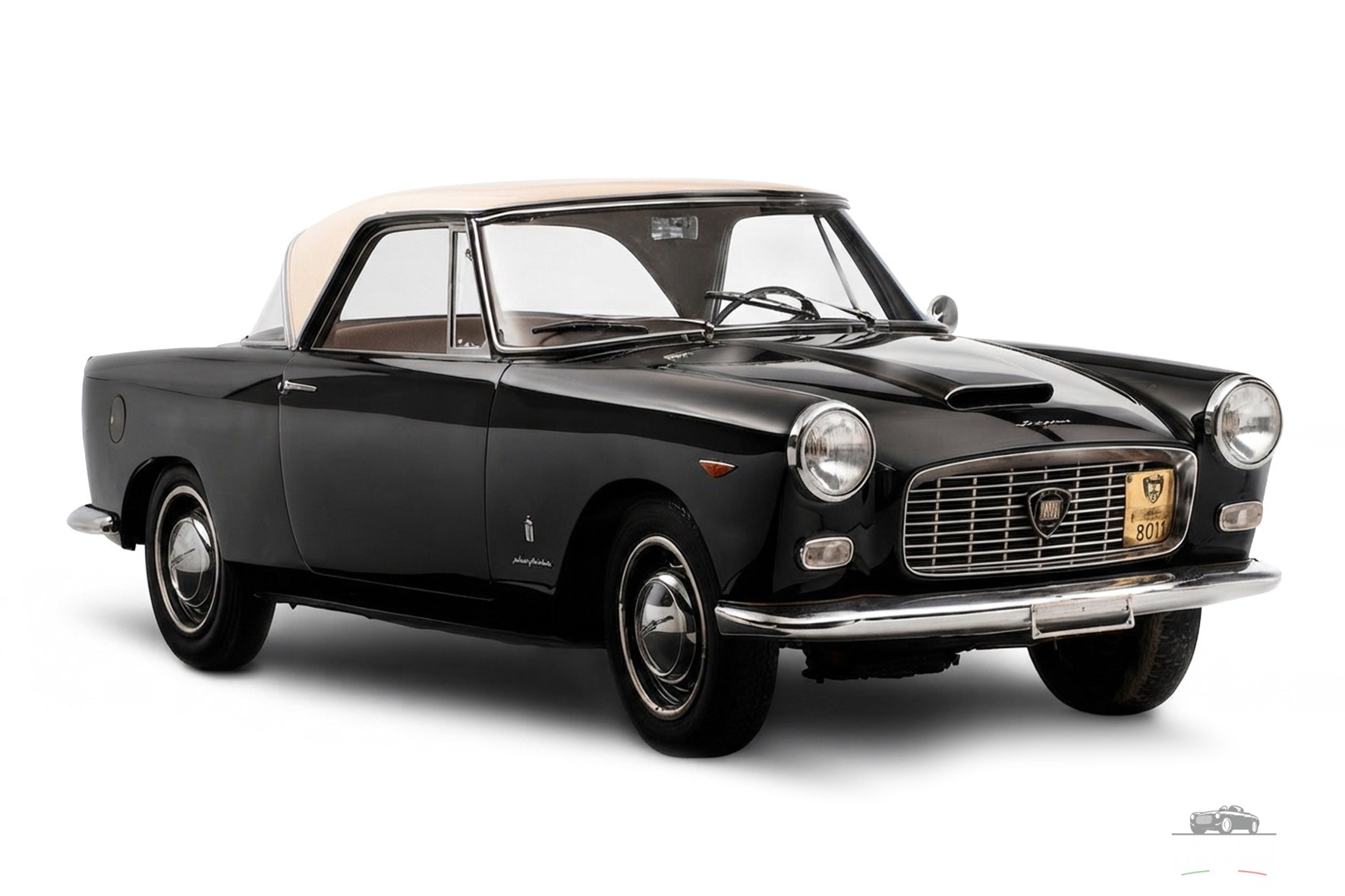
The Lancia Appia Coupé Pininfarina: After the creation of a first “one-off” with a decidedly conventional line, Pininfarina makes a second berlinetta that is more attractive and more original. This new creation, a coupé with two seats plus two makeshifts, is first and foremost noted for the large glass surfaces that make it very streamlined, for the design of the pavilion, whose “V”-shaped side pillar (with the directional repeater initially inserted at the apex of the “V”) breaks traditional patterns, and for the front end inspired by that of the Flaminia (which anticipates what would characterize the third-series sedan two years later). The Lancia-Pininfarina duo presented this coupé in near-final form at the Geneva Motor Show in March ’57. Less than two months later, in early May, the new car (which is marketed by the Lancia organization) enters the list. Compared to the pre-series version, the “definitive” Lancia Appia Coupé Pininfarina differs mainly in the tail lights, where the round taillights (supported by a gaudy chrome bracket) give way to dihedral lights incorporated into the fins (now more pronounced) and additional red lights mounted just above the bumper. Other differences can be seen in the front end, where the grille appears modified and the taillights are rectangular instead of round. Built on the chassis set up by the Turin-based manufacturer for “off-the-shelf” creations equipped with a more powerful engine and a cloche-operated gearbox the master Pininfarina’s creature, a real gem, is also notable for its well-kept interior, which features two folding front seats and a rear bench seat and which, as was fashionable at the time, is defined as a “two-seater coupe plus two makeshift.” Another feature of this car is its two-tone color scheme, with the headliner thus highlighted and appearing to almost visually simulate a “soft top”: note that the headliner is surrounded by a chrome trim that emphasizes its “V” design. Few changes it underwent in its six years of life. The first are in 1957, after only a few examples, when the italicized “Pininfarina” inscription under the side badges disappears, the flasher inside the “V” is suppressed, and new wheel cups are fitted (they are those of the Appia sedan). Also abolished were the two small “crossed” flags applied in early examples on the trunk lid and ashtray. In the spring of 1959 after the launch of the third series of the sedan the derivatives (and thus also this coupe) enjoy a meager increase in power (from 53 to 54 hp) then, in early 1960, we have the adoption of the double braking circuit, the modification to the rear lights and the addition of the side flashing repeater (these last two changes are imposed by the rules of the new Highway Code). Meanwhile, the assembly of the car, initially taken care of by Pininfarina itself, is “turned over” to Carrozzeria Viotti (for reasons of production organization) without, however, changing anything in the line or finish. In the spring of ’60 the latest technical updates: a new cylinder head, a new manifold with separate fuel lines, a new carburetor and changes to the distribution increase its power, which thus reaches 60 hp. Although the competition from the contemporary Alfa Romeo Giulietta Sprint is indeed very strong, this elegant coupe manages to carve out its own albeit tiny space (what in the third millennium we refer to as a “niche”) and obtains a fair amount of success-so much so that it is the most popular of the Appia’s off-roaders…. “standard” also because of the grip it exerts on the female public. One of the most beloved actresses of the time, Sylva Koscina, in the filming of Luigi Zampa’s film Il vigile (shot in 1960), in which she appears alongside Alberto Sordi, appears driving an Appia coupe: it seems that the car was owned by the actress, who claimed to be able to drive only one car: her Appia Pininfarina.
02 / TECHNICAL IDENTITY
03 / DESIGN, BODY & SUPPLIERS
Coachbuilder / Design studio
Founded by Battista Pinin Farina in Turin in 1930, Pininfarina became one of the most influential Italian styling and coachbuilding houses, particularly through its work for Ferrari and other international manufacturers.
Explore record ↗Attributed designer
Pinin Farina designer credited with a 1952 aerodynamic berlinetta study and an early Bentley proposal; also linked to Fiat 1400 and Lancia projects.
Explore record ↗04 / CHRONOLOGY
05 / PEOPLE, COLLECTIONS & MUSEUMS
07 / CHASSIS REGISTER
08 / GALLERY
THE CONVERSATION
Comments 0