
Boneschi
Carrozzeria Boneschi developed from a Lombard coachbuilding business into a specialist producer of individual automobile bodies, commercial conversions and distinctive post-war projects.
Explore record ↗
1951Coachwork by Boneschi
THE VEHICLE AT A GLANCE
THE PEOPLE BEHIND THE CAR
Carrozzeria Boneschi developed from a Lombard coachbuilding business into a specialist producer of individual automobile bodies, commercial conversions and distinctive post-war projects.
Explore record ↗01 / THE STORY
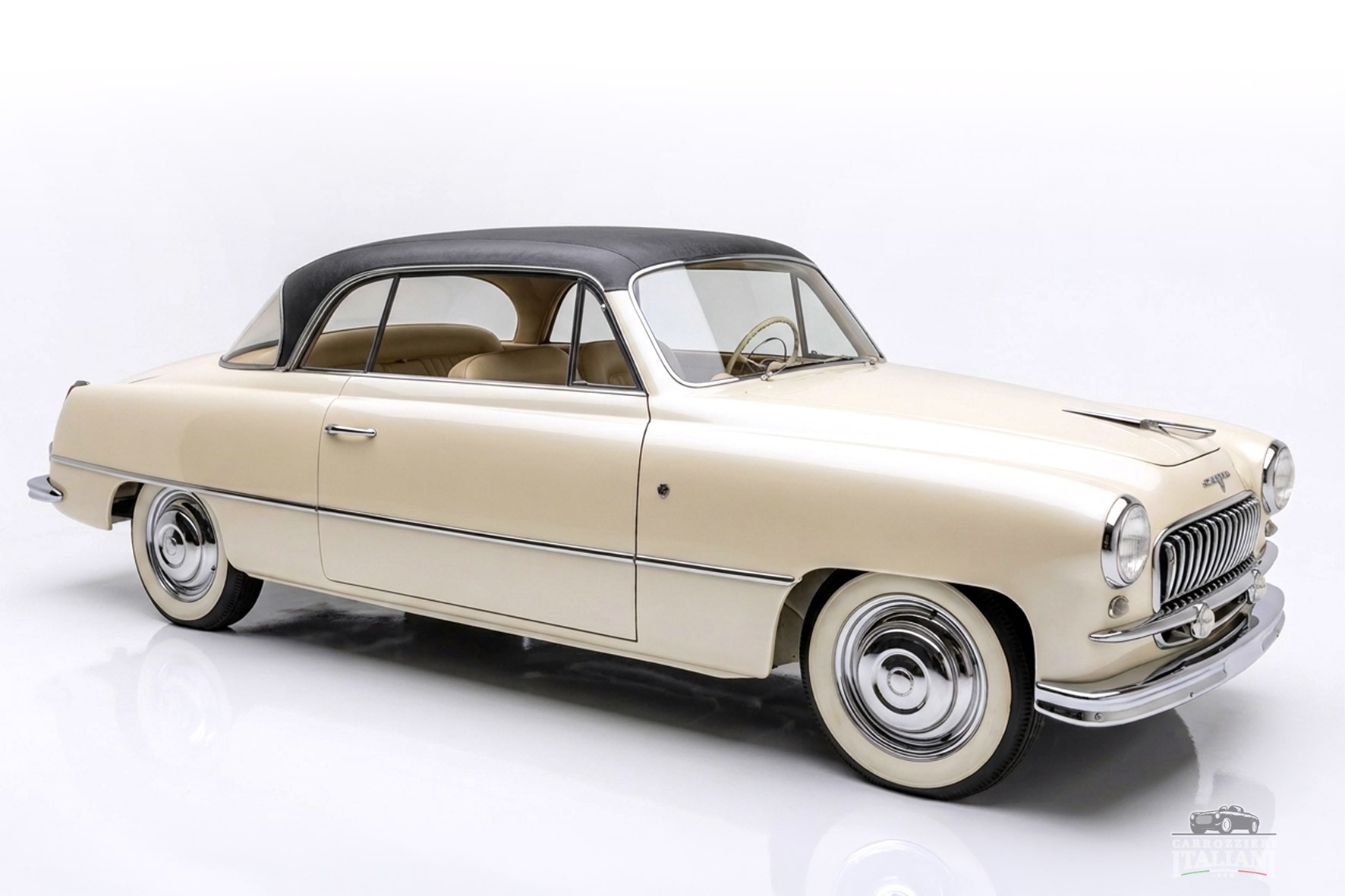
This Lancia Aurelia B50 Faux Cabriolet was designed and bodied by Carrozzeria Boneschi and exhibited at the 1951 Turin Auto Salon. It represents a transitional phase in postwar Italian automotive styling, where classical formalism coexisted with emerging modernist influences. The vehicle shares its principal body design with the known chassis B50-1122, though it is distinguished by a unique two-tone paint scheme. The darker upper section, extending over the roof and down the pillars, was intended to evoke the appearance of a traditional fabric convertible top’a stylistic device inherited from prewar design vocabulary. The car is built on the standard Lancia Aurelia B50 chassis, introduced in 1950 as the basis for custom-bodied versions of the Aurelia. The B50 employed Lancia’s narrow-angle 1,754?cc V6 engine, the first production V6 in the world, developed under the direction of engineer Francesco De Virgilio. Output was rated at approximately 56 horsepower, with power delivered to the rear wheels via a four-speed transaxle gearbox incorporating an integrated differential and inboard brakes. Independent front suspension and a rigid rear axle with semi-elliptic leaf springs were standard. Boneschi’s treatment of the B50 platform involved smooth, restrained volumes with a strong emphasis on horizontality. The profile is clean and symmetrical, with a low beltline and modestly curved fenders. Bright trim was used sparingly, reinforcing the sober elegance typical of Boneschi’s postwar work. The painted “faux cabriolet” roof effect added a decorative element while recalling the prewar cabriolet de ville typology. Inside, the car featured a full metal roof and fixed side glass, confirming its status as a coupe despite the convertible illusion. This stylistic compromise was characteristic of many early 1950s show cars, intended to provide visual novelty while preserving structural rigidity and manufacturing simplicity. The vehicle is one of a small number of Boneschi-built Aurelia B50s and offers a rare example of the coachbuilder’s experimentation with trompe-l’il effects and prewar visual references during Italy’s postwar design recovery. Its appearance at the 1951 Turin Salon positions it within the early commercial trajectory of the Aurelia series and within the broader evolution of Italian bespoke automotive bodywork.
02 / TECHNICAL IDENTITY
03 / DESIGN, BODY & SUPPLIERS
Coachbuilder / Design studio
Carrozzeria Boneschi developed from a Lombard coachbuilding business into a specialist producer of individual automobile bodies, commercial conversions and distinctive post-war projects.
Explore record ↗04 / CHRONOLOGY
07 / GALLERY
THE CONVERSATION
Comments 0