
Fantuzzi
Carrozzeria Fantuzzi was a Modena workshop associated with Medardo and Gino Fantuzzi, renowned for lightweight racing bodies for Maserati and Ferrari, alongside bespoke sporting commissions.
Explore record ↗
1955Coachwork by Fantuzzi
THE VEHICLE AT A GLANCE
THE PEOPLE BEHIND THE CAR
Carrozzeria Fantuzzi was a Modena workshop associated with Medardo and Gino Fantuzzi, renowned for lightweight racing bodies for Maserati and Ferrari, alongside bespoke sporting commissions.
Explore record ↗01 / THE STORY
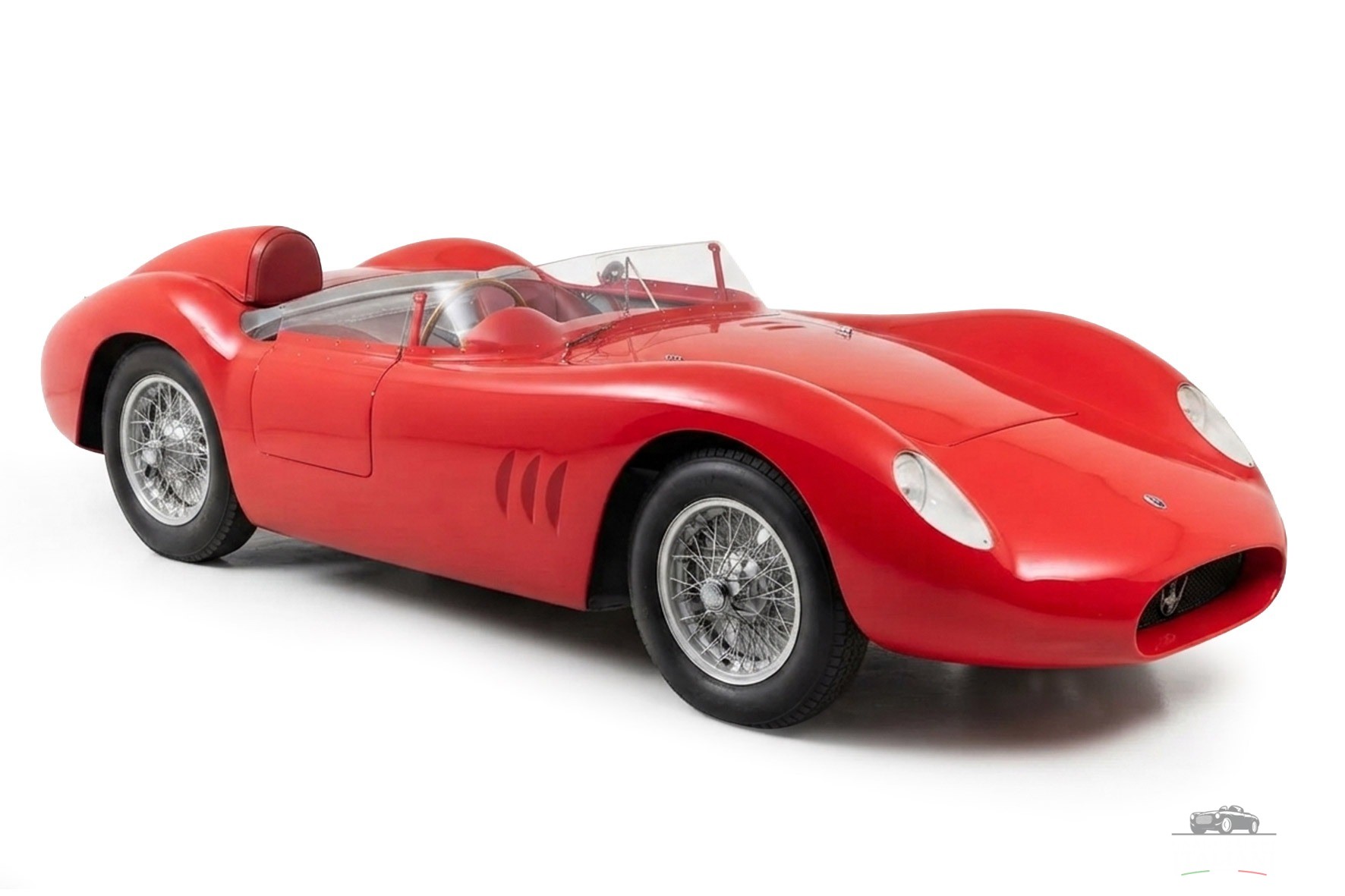
The Maserati 200S was a sports-racing car developed by Maserati in the mid-1950s under the internal designation Tipo 52, conceived as a successor to the A6GCS and intended for competition in the 2-liter category. Introduced in 1955, the model emerged alongside the closely related 150S as part of a broader four-cylinder racing program derived from Maserati’s contemporary engine development. Although a new six-cylinder engine had entered production in the same period, Maserati engineering rapidly adapted its architecture into twin-spark inline four-cylinder units of 1.5 and 2.0 liters, forming the basis of the 150S and 200S respectively. The 200S employed a light-alloy, inline four-cylinder engine with dual overhead camshafts and hemispherical combustion chambers, displacing 1,994.3 cc. Induction was via twin Weber carburetors, initially 50DCO3 units and later 45DCO3s, with peak output of approximately 190 PS at 7,500 rpm. The powertrain was mounted in a tubular steel spaceframe chassis. Front suspension consisted of double wishbones with coil springs, while early cars used a live rear axle before later examples adopted a De Dion configuration to improve handling characteristics. The gearbox was a rear-mounted transaxle, contributing to balanced weight distribution. Bodywork for the 200S followed the open sports-racer tradition of the period. The first five examples were bodied by Celestino Fiandri, while the remaining cars received coachwork from Carrozzeria Fantuzzi under Medardo Fantuzzi. These bodies featured enveloping fenders, a compact oval grille opening, and a rear headrest fairing, closely related in form to the smaller 150S and visually aligned with the contemporary 300S. The design emphasized reduced frontal area and smooth airflow within the empirical aerodynamic understanding of the era. The 200S made its competitive debut in 1955 and achieved significant results during the 1956 season, including an overall victory at the Gran Premio di Roma driven by Jean Behra and a second-place finish at the Supercortemaggiore at Monza with Stirling Moss and Cesare Perdisa. Regulatory changes introduced under FIA Appendix C for 1957 required modifications including a full-width windscreen, functional doors, and accommodation for a spare wheel. Cars updated to this specification were designated 200SI, with later examples enlarged to 2.5 liters and identified as 250S. Approximately twenty-eight examples of the 200S, 200SI, and 250S series were constructed between 1955 and 1957, reflecting Maserati’s limited-production competition strategy during this period.
02 / TECHNICAL IDENTITY
03 / DESIGN, BODY & SUPPLIERS
Coachbuilder / Design studio
Carrozzeria Fantuzzi was a Modena workshop associated with Medardo and Gino Fantuzzi, renowned for lightweight racing bodies for Maserati and Ferrari, alongside bespoke sporting commissions.
Explore record ↗Designer
04 / CHRONOLOGY
05 / PEOPLE, COLLECTIONS & MUSEUMS
07 / CHASSIS REGISTER
08 / GALLERY
THE CONVERSATION
Comments 0