
Castagna
The Castagna coachbuilding tradition dates to nineteenth-century Milan, when Carlo Castagna took over an established carriage business. Carrozzeria Castagna later became renowned for luxury bespoke automotive bodies.
Explore record ↗
2002Coachwork by Castagna
THE VEHICLE AT A GLANCE
THE PEOPLE BEHIND THE CAR
The Castagna coachbuilding tradition dates to nineteenth-century Milan, when Carlo Castagna took over an established carriage business. Carrozzeria Castagna later became renowned for luxury bespoke automotive bodies.
Explore record ↗Gioacchino Acampora was an Italian architect and automotive designer based in Milan.
Explore record ↗01 / THE STORY
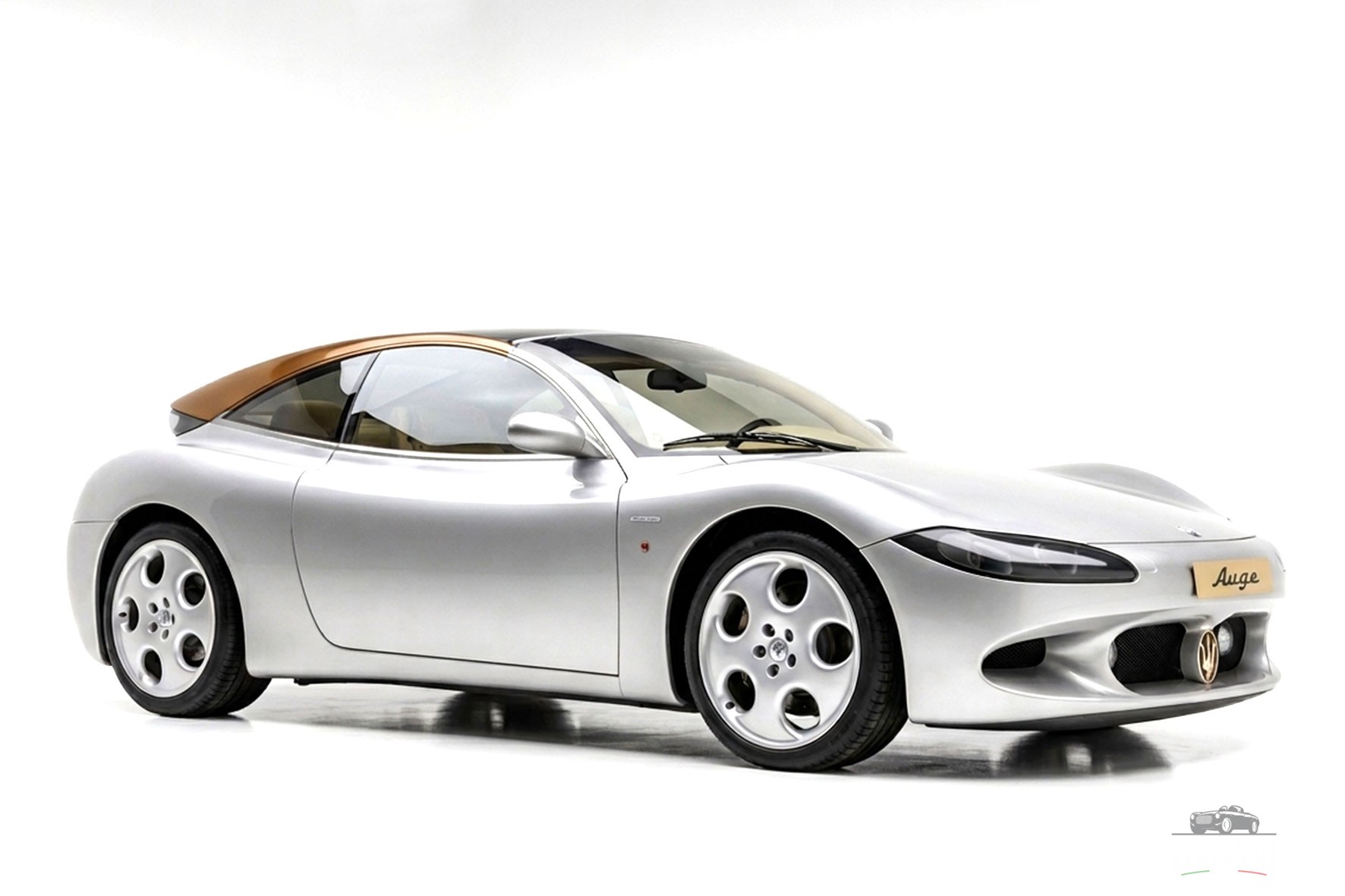
The Maserati Auge is a coachbuilt grand touring concept associated with Gioacchino Acampora and Carrozzeria Castagna Milano. Its design history began in the mid-1990s, in connection with Acampora’s architectural studies at the Politecnico di Milano, and the project was subsequently revised. The 2002 date applied to this catalogue record refers to the later version, rather than establishing the year in which the initial design originated. Acampora’s published professional history identifies the Auge among Castagna’s projects of 2002, while other historical listings date the original concept to 1995.
Acampora’s proposal combined the tradition of Italian coachbuilding with the design of a contemporary four-seat grand tourer. The concept deliberately recalled an era in which Maserati mechanical components could be fitted with individually designed bodies, particularly the grand touring cars of the late 1950s and early 1960s. It was developed outside the regular Maserati production programme, and its styling and construction are attributed to Castagna, rather than to the Maserati factory’s production design team.
The Auge was conceived as a four-seat coupé with two unusually long side doors, a different body arrangement from the four-door saloon commonly identified as its mechanical starting point. Its rounded roof, prominent wheel arches and broad rear section distinguished it from the angular production Quattroporte. Period descriptions refer to large alloy wheels, front air intakes and ducts integrated into the body surfaces. The design’s references to older Maserati grand tourers were principally a matter of proportions and coachbuilding approach rather than literal reproduction of an earlier model.
One distinctive proposed detail was the absence of conventional external door handles. Descriptions associated with the project explain that the doors could be opened remotely through a control incorporated in the driver’s watch, together with an electronic security system. The exterior has been described with contrasting silver and warm, brass-like tones. Accounts also mention aluminium and composite materials, although the available descriptions do not establish the precise material used for every individual panel or component.
The donor platform most often identified for the revised Auge is the fourth-generation Maserati Quattroporte Evoluzione, notably the version with the 3.2-litre twin-turbocharged V8. Maserati’s factory figures for that production model specify a 3,217 cc engine and 335 hp. Those figures document the production Quattroporte, not an independently measured output of the coachbuilt Auge. Some reports claim substantially greater power for the special, but a definitive engine specification or test sheet for the individual car has not been established.
The relationship between the original concept, the later revised car and the exact donor vehicle requires care. Historical accounts have not always agreed on the designation of the underlying Maserati model, and no authenticated chassis or engine number is available in the published material considered here. The precise gearbox fitted to the Auge, the extent of suspension modifications and its individual dimensions therefore remain less securely documented than the standard Quattroporte’s mechanical specification.
The four-seat cabin combined conventional luxury finishes with the communication and entertainment equipment characteristic of advanced design studies of its period. Descriptions refer to leather, woven upholstery, walnut, polished metal and brass-toned details. The dashboard retained an analogue-instrument arrangement, while the proposal placed considerable emphasis on onboard electronics and passenger amenities. Reported equipment included satellite navigation, television, audio and video systems, telephony and a reversing camera.
The specification also described a refrigerated compartment and umbrellas carried in the doors. A transparent section of the roof was intended to admit light into the cabin without dispensing with weather protection. These details belonged to an approach in which the body, interior furnishings and electronic functions were treated as parts of a single individually commissioned-looking design, even though no private commissioning customer is securely identified in the surviving account.
The Maserati Auge Coupé appeared in the prototype category of the Concorso d’Eleganza Villa d’Este, held on 26–28 April 2002, where the entry list identifies it as C02 and associates it with Acampora. This establishes a specific exhibition appearance of the 2002 car without implying an award. Later histories also place the Auge within Castagna’s display activity around the 2003 Geneva Motor Show, although the exact exhibition configuration and documentary attribution require further distinction from the other Castagna specials shown at that event.
The Auge remains principally documented through design descriptions, photographs and retrospective accounts. The public record does not establish an authenticated individual chassis serial, complete ownership history, confirmed production run beyond its treatment as a special project, or a verified auction transaction for this precise vehicle. These gaps are especially relevant when distinguishing the initial mid-1990s concept from its 2002 presentation form.
02 / TECHNICAL IDENTITY
03 / DESIGN, BODY & SUPPLIERS
Coachbuilder / Design studio
The Castagna coachbuilding tradition dates to nineteenth-century Milan, when Carlo Castagna took over an established carriage business. Carrozzeria Castagna later became renowned for luxury bespoke automotive bodies.
Explore record ↗Attributed designer
Gioacchino Acampora was an Italian architect and automotive designer based in Milan.
Explore record ↗04 / CHRONOLOGY
07 / GALLERY
CONTINUE EXPLORING

THE CONVERSATION
Comments 0