
Zagato
Founded in Milan in 1919 by Ugo Zagato, the coachbuilding house developed lightweight aerodynamic bodies inspired by aircraft construction, creating distinctive racing and grand touring automobiles.
Explore record ↗
1984Coachwork by Zagato
THE VEHICLE AT A GLANCE
THE PEOPLE BEHIND THE CAR
Founded in Milan in 1919 by Ugo Zagato, the coachbuilding house developed lightweight aerodynamic bodies inspired by aircraft construction, creating distinctive racing and grand touring automobiles.
Explore record ↗Giuseppe Mittino was an Italian automotive designer associated with Zagato and its specialist lightweight sports-car projects.
Explore record ↗01 / THE STORY
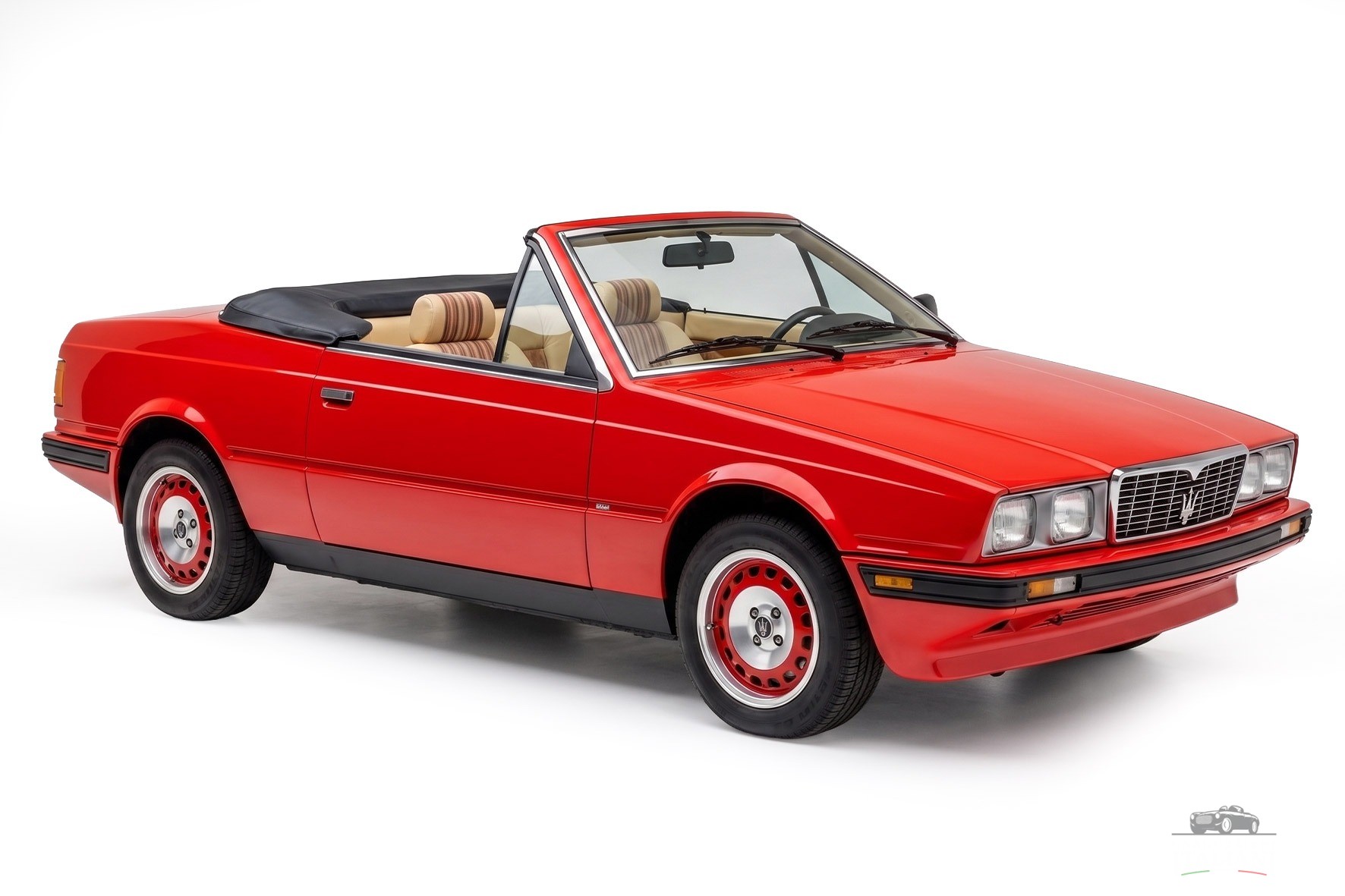
The Maserati Biturbo Spyder was introduced at the Turin Motor Show in 1984 as the open-bodied derivative of the Biturbo coupé. Its design and body production were entrusted to Zagato. The convertible used a shortened version of the Biturbo’s steel monocoque platform, with a wheelbase of 2,400 mm rather than the coupé’s 2,514 mm. The two-door body retained a nominal 2+2 seating arrangement, although the rear seats offered limited accommodation. A folding fabric roof replaced the fixed roof of the coupé.
Zagato produced the Spyder’s bodywork near Milan. The body shells were assembled in Turin and sent to Maserati’s Modena factory for final mechanical completion. The interior incorporated leather upholstery and the dashboard clock used on contemporary Biturbo models. The open body had revised rear bodywork to accommodate the folded roof.
The early Spyder used a twin-turbocharged 90-degree V6 engine. Italian-market cars initially used a 1,996 cc unit, while export-market models were offered with a larger 2.5-litre engine. The original 2.0-litre version developed 180 CV at 6,000 rpm; subsequent fuel-injected versions were rated at 185 CV and later 220 CV in the 1990 specification. Later Spyder variants also used the 2.8-litre V6, although the 24-valve version was not fitted to the open car. Engine output, fuel delivery and dry weight therefore differed across model years and markets.
Maserati’s version records identify 276 examples of the 1984–1986 two-litre Spyder, 297 examples of the 1986–1988 Spyder i and 122 examples of the 1989–1992 Spyder i (1990). These are separate version totals, not a count of all Spyder production. The short-wheelbase chassis was also used for the Maserati Karif coupé. The Biturbo-derived Spyder range continued through successive mechanical and styling revisions until 1994.
02 / TECHNICAL IDENTITY
03 / DESIGN, BODY & SUPPLIERS
Coachbuilder / Design studio
Founded in Milan in 1919 by Ugo Zagato, the coachbuilding house developed lightweight aerodynamic bodies inspired by aircraft construction, creating distinctive racing and grand touring automobiles.
Explore record ↗Designer
Giuseppe Mittino was an Italian automotive designer associated with Zagato and its specialist lightweight sports-car projects.
Explore record ↗Become a Pro member to see the full details in this section.
Membership is not available yet.
View membership options04 / CHRONOLOGY
07 / GALLERY
THE CONVERSATION
Comments 0