Coggiola
Founded in Turin in 1966 by Sergio Coggiola after his work at Ghia, Carrozzeria Coggiola built specialist automotive bodies and design prototypes, including projects for Saab.
Explore record ↗
2003
THE VEHICLE AT A GLANCE
THE PEOPLE BEHIND THE CAR
Founded in Turin in 1966 by Sergio Coggiola after his work at Ghia, Carrozzeria Coggiola built specialist automotive bodies and design prototypes, including projects for Saab.
Explore record ↗01 / THE STORY
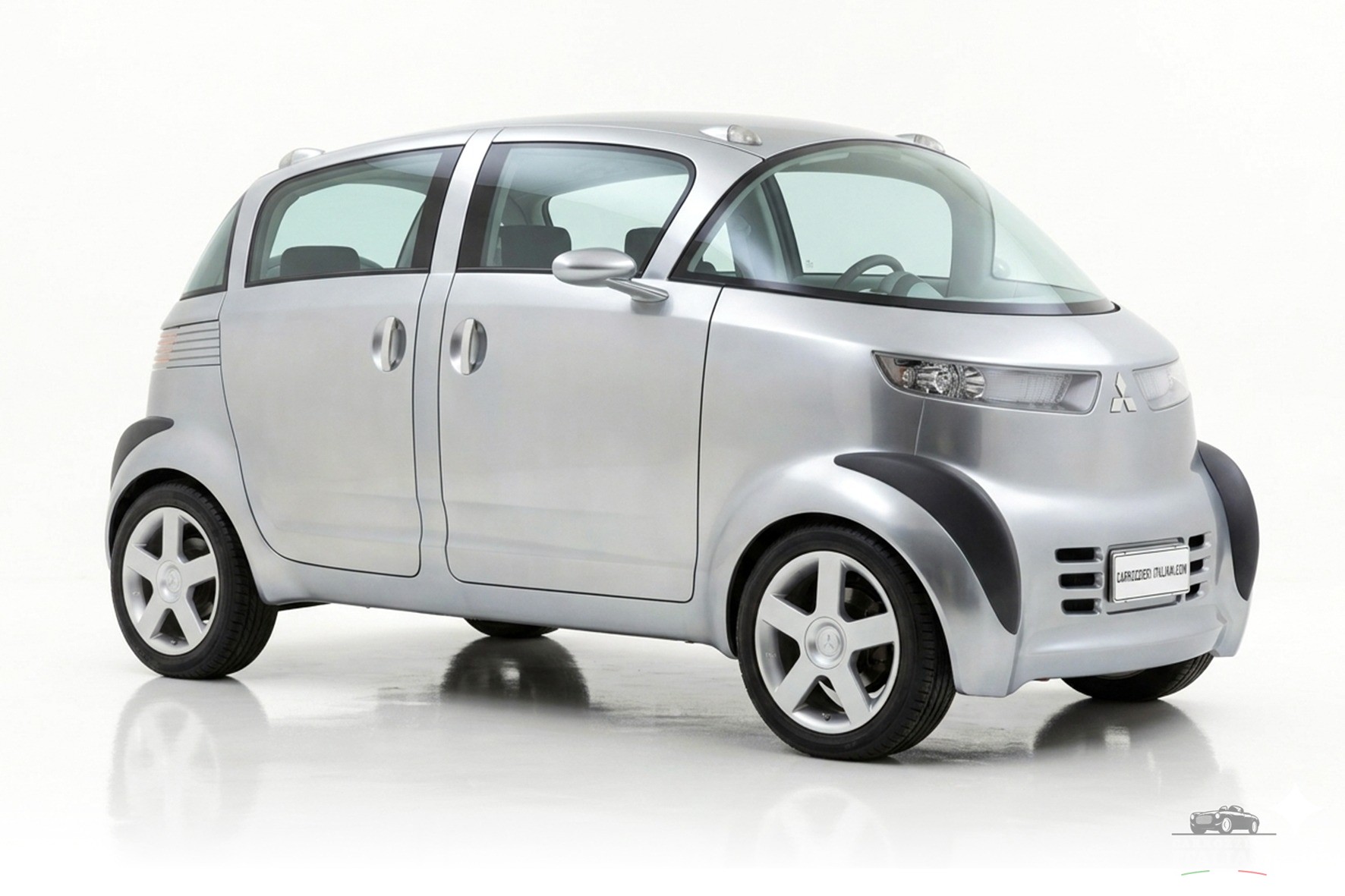
The Mitsubishi SE-RO was a concept vehicle developed in 2003 through a collaborative design effort between Mitsubishi Motors and Carrozzeria Coggiola of Turin. Conceived as an experimental study in personal mobility, the SE-RO was publicly presented at the Tokyo Motor Show that same year. The name, an abbreviation of “Secret Room,” reflected the project’s emphasis on interior spatial reconfiguration and personal retreat, positioned within the legal and dimensional constraints of Japan’s kei car category. The vehicle was built upon Mitsubishi’s MR platform, employing a mid-engine, rear-wheel-drive layout. Propulsion was provided by a turbocharged 660 cc inline-three engine, paired with a continuously variable transmission. The platform permitted compact external dimensionsapproximately 3.4 meters in lengthwhile maximizing cabin volume. The chassis and powertrain remained within the regulatory limits for kei vehicles, though the SE-RO was never homologated for production. The exterior was rendered in polished aluminum and drew formal inspiration from mid-century aeronautical design. Wraparound glass, rounded bodywork, and flush detailing recalled streamlined fuselage construction, while evoking futurist idioms of mid-20th-century industrial design. The result was a monovolume silhouette free from historical automotive typologies. Carrozzeria Coggiola’s contribution lay not only in form but in the fusion of European stylistic refinement with Mitsubishi’s functional engineering. Internally, the SE-RO departed entirely from conventional automotive spatial arrangements. Rear seating was reconfigurable, capable of forming a lounge environment centered on a retractable table. The driver’s seat could be rotated to face rearward, allowing the cabin to transform from a transport mechanism into a static social or contemplative enclosure. Upholstery and materials were selected for tactility and warmth, contrasting with the vehicle’s exterior metallic severity. Only a single example of the Mitsubishi SE-RO is known to exist. It remains part of Mitsubishi’s design archive and has been exhibited sporadically as a representation of the company’s early 21st-century conceptual direction. The SE-RO is not remembered for technical novelty or performance metrics but for its inquiry into automotive space as a domain of privacy and adaptabilityan ephemeral but articulate answer to questions of interior architecture and vehicular identity.
02 / TECHNICAL IDENTITY
03 / DESIGN, BODY & SUPPLIERS
Coachbuilder / Design studio
Founded in Turin in 1966 by Sergio Coggiola after his work at Ghia, Carrozzeria Coggiola built specialist automotive bodies and design prototypes, including projects for Saab.
Explore record ↗07 / GALLERY
THE CONVERSATION
Comments 0