
Pininfarina
Founded by Battista Pinin Farina in Turin in 1930, Pininfarina became one of the most influential Italian styling and coachbuilding houses, particularly through its work for Ferrari and other international manufacturers.
Explore record ↗
1965
THE VEHICLE AT A GLANCE
THE PEOPLE BEHIND THE CAR
Founded by Battista Pinin Farina in Turin in 1930, Pininfarina became one of the most influential Italian styling and coachbuilding houses, particularly through its work for Ferrari and other international manufacturers.
Explore record ↗01 / THE STORY
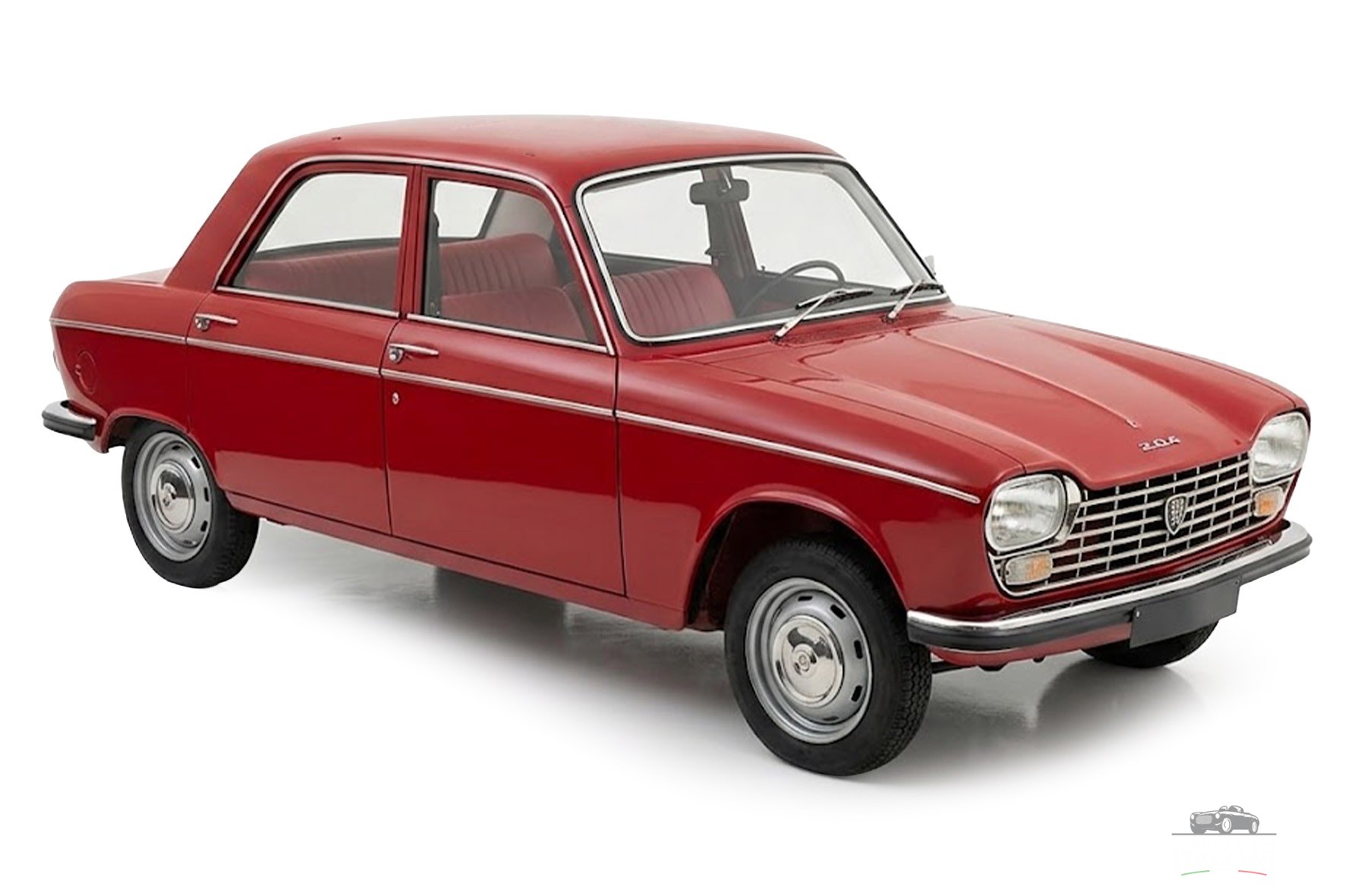
Introduced at the 1965 Geneva Motor Show, the Peugeot 204 marked a significant evolution in the French manufacturer’s model range. Developed under project code D12, the car was the first Peugeot to adopt front-wheel drive, as well as an all-aluminium engine mounted transversely. Designed with practicality and modernity in mind, the 204 also set a precedent for subsequent Peugeot models in terms of both engineering layout and design language. The exterior styling of the 204 was developed in close collaboration between Peugeot’s internal design department and Pininfarina. Although the precise division of responsibility remains a subject of some debate, the influence of Pininfarina is apparent in the clean surfaces, restrained ornamentation, and overall proportions. The car adopted a three-box layout with short overhangs and a long wheelbase relative to its compact footprint. The slightly elevated roofline, large glass areas, and slim pillars reflected a focus on visibility and cabin space. Initially launched as a four-door saloon, the 204 range quickly expanded to include a five-door estate (Break), a panel van (Fourgonette), and, in 1966, a two-door coupé and cabriolet. While the coupé and cabriolet variants were shorter in wheelbase and featured distinct bodywork, sources suggest they were developed internally by Peugeot’s design office rather than Pininfarina. Nonetheless, the consistent aesthetic across the range maintained the model’s visual cohesion. Mechanically, the 204 was powered by a 1,130 cc inline-four engine, later standardized at 1,127 cc, producing modest power suitable for the model’s weight. Independent suspension and front disc brakes ensured contemporary levels of handling and braking performance. A four-speed manual gearbox transmitted power to the front wheels. The use of aluminium for the engine and transaxle contributed to weight savings and efficient packaging. Production of the 204 continued until 1976, with over 1.6 million units built across all body types. The model played a pivotal role in repositioning Peugeot in the compact car segment and laid the groundwork for the later success of the 304 and 305. The 204 remains a notable example of mid-century European automotive design and industrial rationalism, exemplifying the balance between engineering innovation and stylistic restraint.
02 / TECHNICAL IDENTITY
03 / DESIGN, BODY & SUPPLIERS
Coachbuilder / Design studio
Founded by Battista Pinin Farina in Turin in 1930, Pininfarina became one of the most influential Italian styling and coachbuilding houses, particularly through its work for Ferrari and other international manufacturers.
Explore record ↗04 / CHRONOLOGY
07 / GALLERY
THE CONVERSATION
Comments 0