
Pininfarina
Founded by Battista Pinin Farina in Turin in 1930, Pininfarina became one of the most influential Italian styling and coachbuilding houses, particularly through its work for Ferrari and other international manufacturers.
Explore record ↗
1979
THE VEHICLE AT A GLANCE
THE PEOPLE BEHIND THE CAR
Founded by Battista Pinin Farina in Turin in 1930, Pininfarina became one of the most influential Italian styling and coachbuilding houses, particularly through its work for Ferrari and other international manufacturers.
Explore record ↗01 / THE STORY
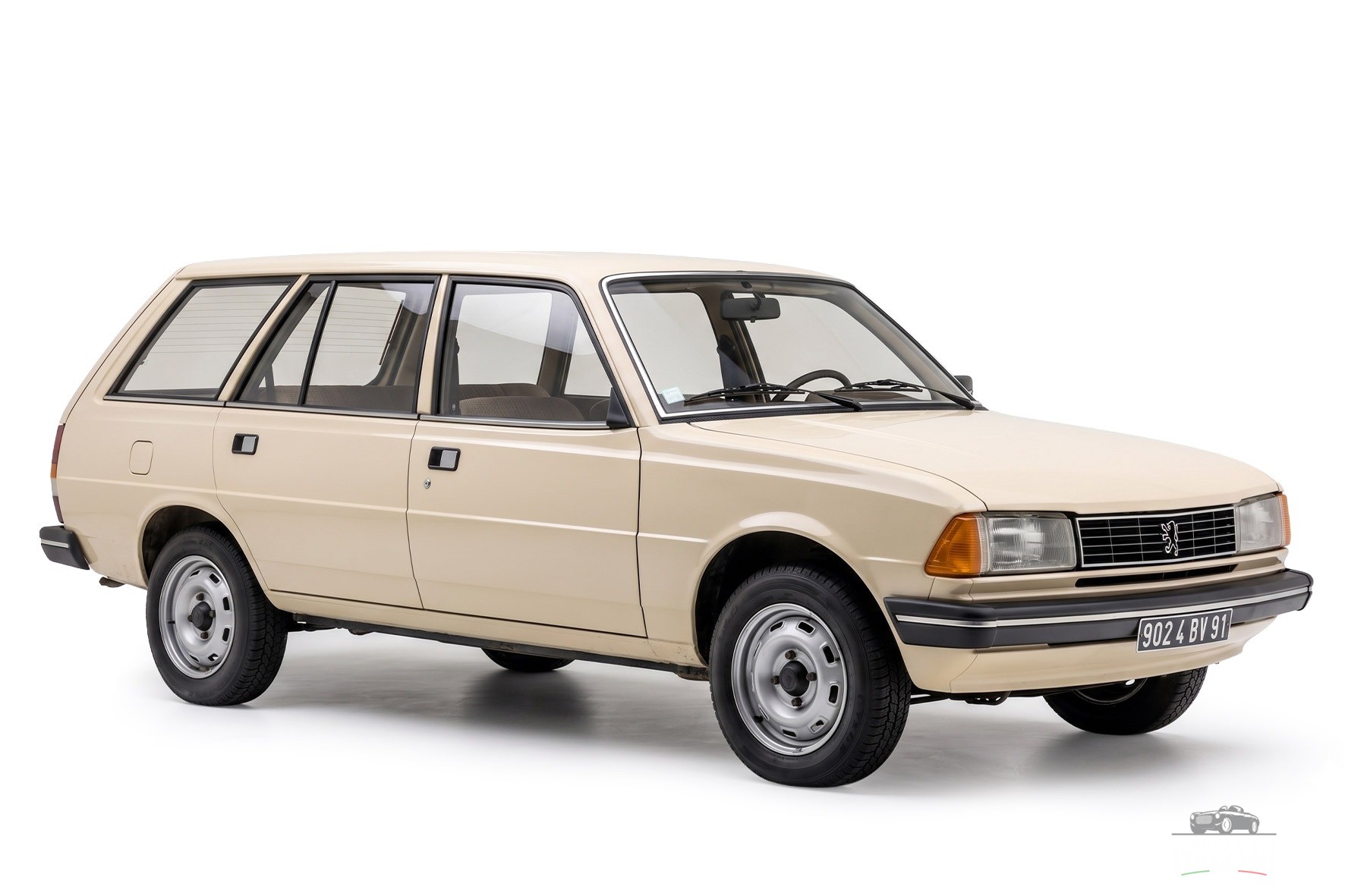
The Peugeot 305 Break, introduced in 1979 as an expansion of the 305 range launched in 1977, was developed to replace the earlier Peugeot 304 estate. Positioned in the C-segment, the 305 Break was designed to provide greater practicality while retaining the restrained styling and compact proportions of its saloon counterpart. It was styled under the guidance of Pininfarina, following a design philosophy already seen in the earlier Peugeot 504. Although the estate retained the front-end appearance of the saloon, its body was extended and reworked from the B-pillar rearward, allowing for a larger cargo area and an extended roofline with integrated roof rails in later variants. The 305 Break measured 4,283 mm in length, 1,630 mm in width, and 1,426 mm in height, offering improved utility over the saloon version. With a rear hatch, flat floor, and a folding rear seat, it was capable of carrying considerable loads for a vehicle of its class. Depending on the version, the rear leaf-spring suspension differed from the saloon’s coil-spring layout to better accommodate cargo requirements. Engine options ranged from 1.3 to 1.9 litres across petrol and diesel variants, with both manual four- and five-speed gearboxes offered. The Break was available in multiple trim levels, including base, GL, GR, SR, and later GRD or SRD for diesel models. Like the saloon, the Break underwent a mid-cycle revision in 1982. This included updates to the front grille, headlights, and interior fittings, with mechanical improvements carried over from the saloon, including revised suspension geometry and upgraded transmissions. The model was shown at the 1979 Geneva Motor Show and again at Paris in 1982 in facelifted form. Production continued until 1988, when it was replaced by the Peugeot 405 Break. The 305 Break played a significant role in Peugeot’s lineup throughout the 1980s, offering a practical, efficient, and conservatively styled estate car in line with the brand’s utilitarian image. While never a high-performance model, it remained a durable and functional choice for both private and commercial use.
02 / TECHNICAL IDENTITY
03 / DESIGN, BODY & SUPPLIERS
Coachbuilder / Design studio
Founded by Battista Pinin Farina in Turin in 1930, Pininfarina became one of the most influential Italian styling and coachbuilding houses, particularly through its work for Ferrari and other international manufacturers.
Explore record ↗07 / GALLERY
THE CONVERSATION
Comments 0