
Pininfarina
Founded by Battista Pinin Farina in Turin in 1930, Pininfarina became one of the most influential Italian styling and coachbuilding houses, particularly through its work for Ferrari and other international manufacturers.
Explore record ↗
1969Coachwork by Pininfarina
THE VEHICLE AT A GLANCE
THE PEOPLE BEHIND THE CAR
Founded by Battista Pinin Farina in Turin in 1930, Pininfarina became one of the most influential Italian styling and coachbuilding houses, particularly through its work for Ferrari and other international manufacturers.
Explore record ↗Franco Martinengo is an Italian automotive designer, design director and painter associated with Turin.
Explore record ↗01 / THE STORY
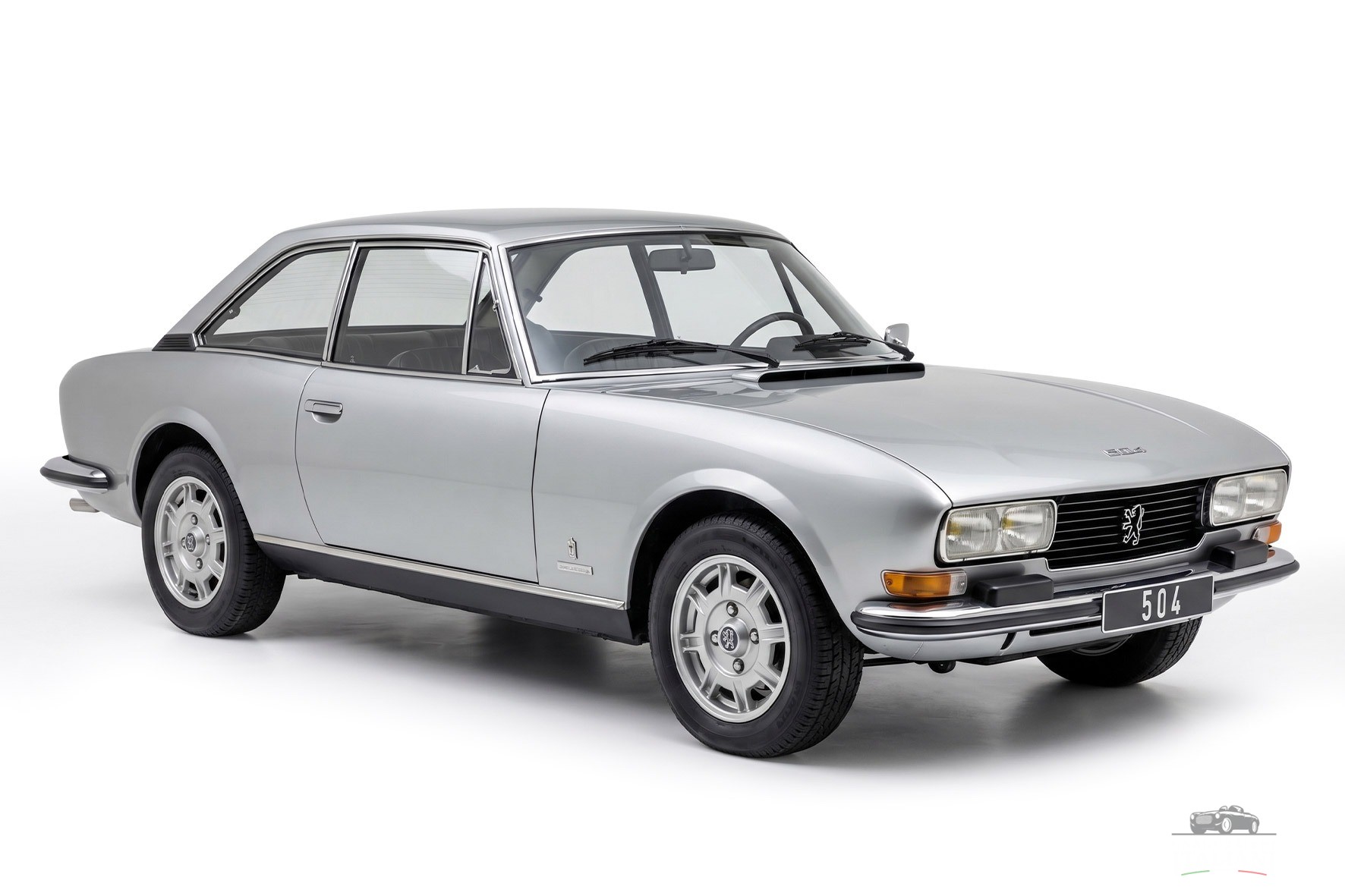
The Peugeot 504 Coupé was introduced in 1969 as a two-door grand touring derivative of the 504 saloon. Designed and built by Carrozzeria Pininfarina, it marked another collaboration between Peugeot and the Italian coachbuilder. The design, supervised by Franco Martinengo at Pininfarina, featured more elegant and fluid proportions than the sedan, with a lower roofline, smooth flanks, and wide C-pillars. The Coupé’s styling emphasized balance and proportion, combining French engineering with Italian aesthetic refinement. Mechanically, the 504 Coupé shared its platform with the saloon but adopted a shorter 2,550 mm wheelbase and specific suspension geometry to enhance handling and comfort. The initial engine was an 1,796 cc inline-four with Kugelfischer mechanical fuel injection, producing 97 hp. In 1970, the engine was enlarged to 1,971 cc and output increased to 106 hp. In 1974, Peugeot introduced the PRV 2,664 cc V6 engine, jointly developed by Peugeot, Renault, and Volvo, which produced 136 hp and provided significantly improved torque delivery. Transmission options included a four-speed manual gearbox, a five-speed manual introduced later, and an optional three-speed automatic. The suspension layout used independent MacPherson struts at the front and semi-trailing arms at the rear. All four wheels were equipped with disc brakes. The emphasis was on stability and smooth ride quality, aligning the Coupé with its role as a grand tourer rather than a pure sports car. Body shells were manufactured at Pininfarina’s Turin facility and transported to Peugeot’s Sochaux plant for final assembly. The interior was trimmed in high-quality materials with instrumentation designed for long-distance touring comfort. Production ran until 1983, with approximately 31,163 units of the Coupé and Cabriolet combined, of which just over 5,500 were V6 models.
02 / TECHNICAL IDENTITY
03 / DESIGN, BODY & SUPPLIERS
Coachbuilder / Design studio
Founded by Battista Pinin Farina in Turin in 1930, Pininfarina became one of the most influential Italian styling and coachbuilding houses, particularly through its work for Ferrari and other international manufacturers.
Explore record ↗Attributed designer
Franco Martinengo is an Italian automotive designer, design director and painter associated with Turin.
Explore record ↗04 / CHRONOLOGY
07 / GALLERY
THE CONVERSATION
Comments 0