

Ghia
Founded in Turin in 1916, Carrozzeria Ghia became a major Italian design and coachbuilding house, creating bespoke automobiles, prototypes and international collaborations across the twentieth century.
Explore record ↗
1962Coachwork by Ghia
THE VEHICLE AT A GLANCE
THE PEOPLE BEHIND THE CAR
Founded in Turin in 1916, Carrozzeria Ghia became a major Italian design and coachbuilding house, creating bespoke automobiles, prototypes and international collaborations across the twentieth century.
Explore record ↗Pietro Frua was an Italian automotive designer and coachbuilder who established his own Turin-based company and became known for elegant, individually styled bodies for European manufacturers.
Explore record ↗01 / THE STORY
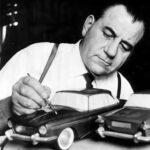
The Renault Caravelle: While at a business meeting in Florida, Renault bosses Pierre Dreyfus and Fernand Picard were inspired to enhance Renault’s image with a sporty little coupe based on the humble Dauphine. Mimicking VW’s own Karmann-Ghia, the new car was based on a bog-standard Dauphine platform but dressed in a pretty new two-door coupe and cabriolet body. And just like their German rivals, Renault turned to Carrozzeria Ghia to design the new car, which would be called the Floride in Europe and Caravelle in the US. The actual design was drawn by the young Ghia employee, Pietro Frua, who did a masterful job of camouflaging the Caravelle’s humble roots. Upon its debut in Geneva, over 8,000 orders poured in and, when the car was shown in the United States for the first time, a further 13,000 orders would follow. When the Dauphine was replaced by the R8 at the end of 1963, the Caravelle continued with subtly reworked styling by the now-independent Pietro Frua and powered by a new five main-bearing 956 cc inline four cylinder engine. For 1965, the Caravelle S was offered with an enlarged 1108 cc version of the R8 engine producing 55 horsepower and with four-wheel Bosch disc brakes, putting the Caravelle in line with other compact sports cars like the Triumph Spitfire and Austin Healey Sprite. Ultimately, the competition from Britain and Germany proved too much for Renault, and the Caravelle quietly disappeared from the lineup after 1967.In the late 1950s, Renault was locked in a battle with Volkswagen for superiority in the burgeoning import car market in America. Affordable foreign cars were just starting to find their footing among U.S. buyers, who still clung loyally to their large and luxurious barges from the big three, but even in the 1950s, fuel efficiency was becoming an increasingly important issue, as was maneuverability in urban environments, where these compact and lightweight cars were at their best. Renault had been playing second fiddle to Volkswagen was looking to up their game in this competitive and fast-growing new market. On paper, the Renault Dauphine actually shared many characteristics with the Beetle, namely the rear engine layout, basic construction, and styling that leaned toward the quirky and cute. The Dauphine offered perhaps greater practicality with its four-door body, but Volkswagen seemed to have a stranglehold on the market thanks to strong marketing and an ever-growing cult-following.
Photo courtesy of Hyman Ltd.
02 / TECHNICAL IDENTITY
03 / DESIGN, BODY & SUPPLIERS
Coachbuilder / Design studio
Founded in Turin in 1916, Carrozzeria Ghia became a major Italian design and coachbuilding house, creating bespoke automobiles, prototypes and international collaborations across the twentieth century.
Explore record ↗Designer
Pietro Frua was an Italian automotive designer and coachbuilder who established his own Turin-based company and became known for elegant, individually styled bodies for European manufacturers.
Explore record ↗04 / CHRONOLOGY
07 / GALLERY
THE CONVERSATION
Comments 0