
Zagato
Founded in Milan in 1919 by Ugo Zagato, the coachbuilding house developed lightweight aerodynamic bodies inspired by aircraft construction, creating distinctive racing and grand touring automobiles.
Explore record ↗
2012
THE VEHICLE AT A GLANCE
THE PEOPLE BEHIND THE CAR
Founded in Milan in 1919 by Ugo Zagato, the coachbuilding house developed lightweight aerodynamic bodies inspired by aircraft construction, creating distinctive racing and grand touring automobiles.
Explore record ↗01 / THE STORY
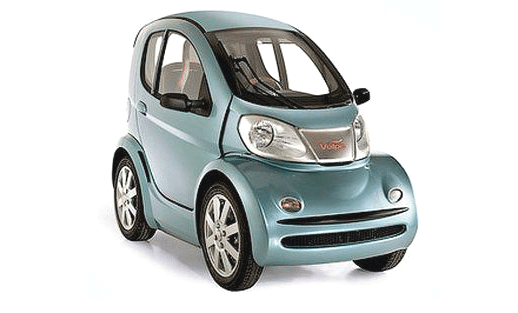
The Volpe (V.O.L.P.E.) is an electric urban quadricycle project developed by the Italian Volpe company, with exterior styling by Zagato. A revised version was publicised in 2012, following an earlier concept associated with the same name in 2005. The programme was linked to entrepreneur Romano Artioli and proposed a compact, enclosed alternative to larger city cars. Volpe was the vehicle marque and project organisation; Zagato’s documented contribution was design, rather than the manufacture of an established production series.
The 2012 vehicle was conceived for two occupants seated in tandem, reducing cabin width to approximately one metre. Its enclosed body, glazing and upward-opening side doors distinguished it from open-sided urban quadricycles. Period descriptions referred to a steel structural shell or platform and aluminium door panels. Folding the rear passenger accommodation was said to provide up to 175 litres of luggage space. Contemporary specifications disagree over the overall length: some gave 2.0 metres, while several subsequent reports quoted approximately 2.2 metres. Neither dimension should be treated as the confirmed measurement of every development vehicle.
The Volpe belonged to a broader period of experimentation with Italian urban-car concepts, although its propulsion, layout and intended regulatory category were specific to this programme. Period publicity described four-wheel disc brakes, regenerative braking and the possible availability of ABS, electronic stability control and a driver airbag. These systems were not necessarily standard equipment on every proposed version. A photovoltaic film was also described as an option for supplementing battery charging, rather than an independent power source for the vehicle.
Four named versions were announced: Globo, Goal, Graffio and Guru. The Globo was the purely electric entry model, advertised with a 4 kW motor and an urban range of approximately 50–70 km. The Goal retained a 4 kW electric drivetrain but added a small petrol- or natural-gas-powered generator intended to charge the traction batteries. The Graffio combined the range-extender arrangement with an 8 kW electric drive. The Guru was presented as the most powerful version, with a total of 12 kW and electric drive at both axles. These ratings and configurations describe the announced variants, not a single engine specification applicable to all Volpe vehicles.
Initial battery information referred to lead-acid units with a lithium-ion alternative. The extended-range variants were advertised with a combined operating range reaching approximately 350–380 km; these were projected figures, not independently established road-test results. The combustion unit served as a generator rather than as a conventional mechanical drive to the wheels. Contemporary accounts also distinguished the speed-limited lighter versions from the more powerful proposed configurations.
Press demonstrations and reports in 2012 presented the vehicle as a forthcoming commercial quadricycle, with deliveries subsequently anticipated during 2013. A January 2013 report again described the four-model range. Such announcements document the marketing and development timetable but do not establish how many vehicles were ultimately assembled, delivered or registered. No individual chassis number has been securely associated with this general programme record, and a production total should not be inferred from the number of announced variants. The Volpe is therefore recorded here as a contemporary electric microcar project with a documented Zagato styling contribution and an unconfirmed final manufacturing volume.
02 / TECHNICAL IDENTITY
03 / DESIGN, BODY & SUPPLIERS
Coachbuilder / Design studio
Founded in Milan in 1919 by Ugo Zagato, the coachbuilding house developed lightweight aerodynamic bodies inspired by aircraft construction, creating distinctive racing and grand touring automobiles.
Explore record ↗CONTINUE READING
How did Italy’s famed coachbuilders go from designing Ferraris to dreaming up tiny electric runabouts? From the quirky Tsé-Tsé to Pininfarina’s visionary Nido, discover how city cars became a proving ground for…
Read storyFew names in Italian coachbuilding describe a philosophy as clearly as Zagato. Founded in Milan in 1919 by Ugo Zagato—an engineer steeped in aeronautical construction rather than coachwork convention—the atelier did not…
Read story
THE CONVERSATION
Comments 0