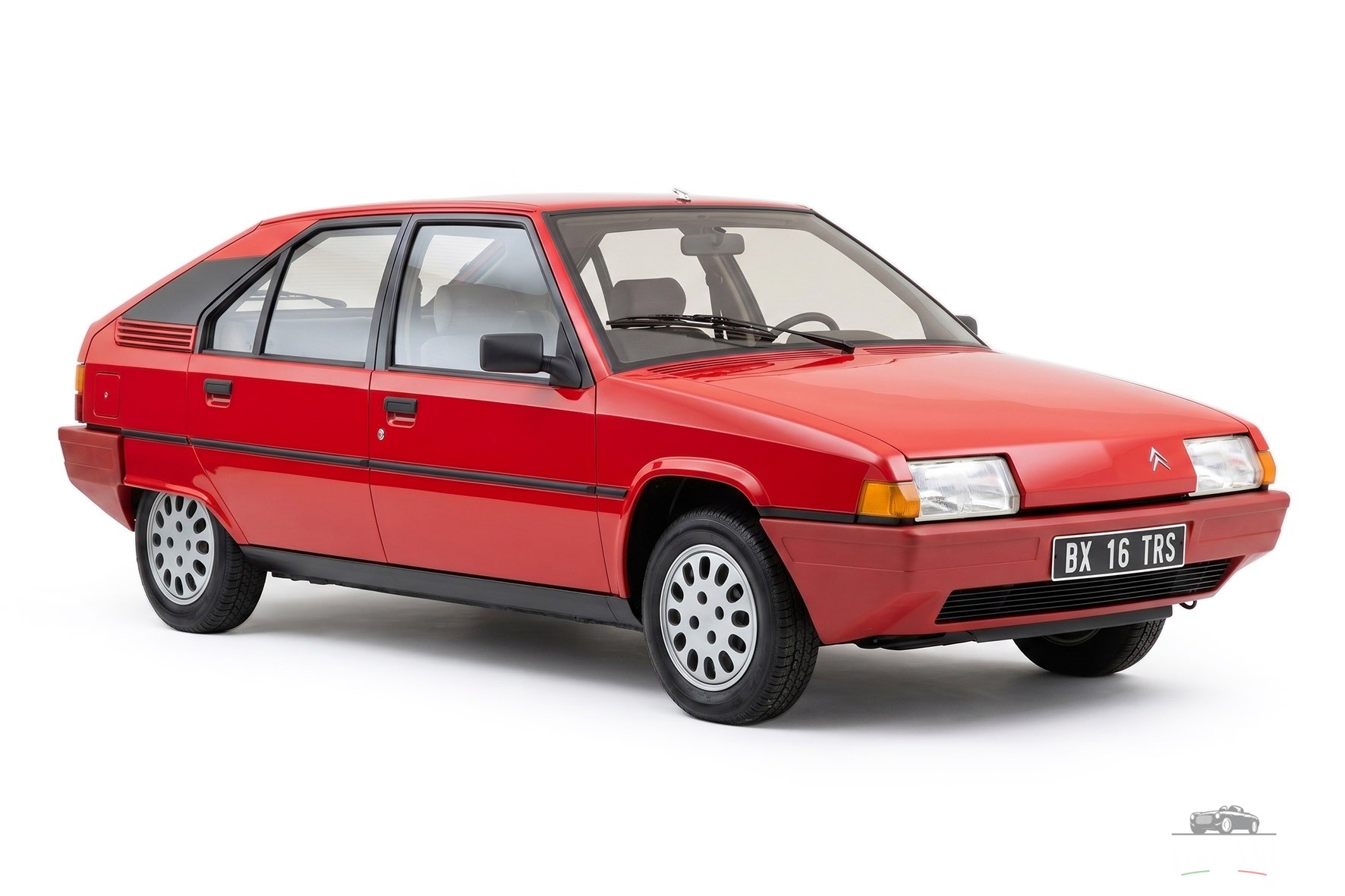
The Citroën BX was introduced in 1982 as the French manufacturer’s new family car, combining the engineering traditions of Citroën with an exterior design developed in Italy. Citroën entrusted the styling programme to Bertone, where Marcello Gandini shaped the BX’s angular, sharply defined five-door silhouette. Bertone’s contribution was the design: the BX was a Citroën series-production automobile, not a model whose millions of bodies were manufactured by the Turin coachbuilder. Development of the project, internally designated XB, began in 1978, with the technical brief finalised in November 1979 at Citroën’s Vélizy engineering centre.
The BX’s styling belongs to a broader sequence of Bertone experiments. Citroën’s own historical account identifies the front-end treatment of the Citroën GS Camargue of 1972 and the architecture of the Volvo Tundra of 1979 as important points of reference. The earlier Reliant FW11 is also associated with this design lineage, although the precise direction of individual design transfers requires further archival evidence. The resulting BX was a distinctive two-box hatchback with partially enclosed rear wheels, a low bonnet and large glazed areas, bringing Gandini’s geometric vocabulary into a mass-produced Citroën.
Engineering and introduction
Under its new body the BX retained several defining Citroën principles: front-wheel drive, transverse engines, hydropneumatic self-levelling suspension and four-wheel disc brakes. The original range used 1,360 cc and 1,580 cc petrol engines from the PSA component family, with different power outputs according to trim. Citroën also employed composite materials for components such as the bonnet and tailgate, while its published development account quoted a drag coefficient of 0.34. The five-door launch hatchback measured 4,230 mm long, 1,650 mm wide and 1,358 mm high; these dimensions should not be applied indiscriminately to later estate versions.
The BX was unveiled beneath the Eiffel Tower in September 1982, ahead of its appearance at the Paris Motor Show, which opened on 30 September. Citroën’s historical publications differ on the exact date of the Eiffel Tower presentation, giving 23 and 25 September respectively. The French launch range comprised the BX, 14 E, 14 RE, 16 RS and 16 TRS, with published original prices from 48,900 to 59,800 French francs depending on version. These were new-car list prices, not recorded transactions for individual surviving examples.
Production and subsequent developments
Manufactured primarily at Citroën’s Rennes-La Janais and Vigo facilities, the BX became one of the marque’s most successful post-merger models. Citroën’s 2022 historical release records 2,337,016 units and the end of production in June 1994; a 2020 company history quotes a smaller total for a more restricted production period and scope. The range expanded to include diesel models, the Break/Evasion estate introduced in 1985, a major facelift in 1987, performance versions and four-wheel-drive derivatives. The estate was developed and built by Heuliez, a separate coachbuilding contribution that should not be confused with Bertone’s design of the original hatchback. The Citroën Zabrus, presented by Bertone in 1986, explored another body style using the specialised BX 4TC mechanical basis rather than a standard BX chassis. The Citroën Xantia later succeeded the BX in the range.



THE CONVERSATION
Comments 0