

Castagna
The Castagna coachbuilding tradition dates to nineteenth-century Milan, when Carlo Castagna took over an established carriage business. Carrozzeria Castagna later became renowned for luxury bespoke automotive bodies.
Explore record ↗
2003Coachwork by Castagna
THE VEHICLE AT A GLANCE
THE PEOPLE BEHIND THE CAR
The Castagna coachbuilding tradition dates to nineteenth-century Milan, when Carlo Castagna took over an established carriage business. Carrozzeria Castagna later became renowned for luxury bespoke automotive bodies.
Explore record ↗Gioacchino Acampora was an Italian architect and automotive designer based in Milan.
Explore record ↗01 / THE STORY
The Alfa Romeo G.C. was a two-seat coupé presented by Carrozzeria Castagna Milano in 2003. Before its public unveiling the project had been known by the working name Ginevra, retained in some later catalogues. The G.C. designation was explained at the time as referring to the initials of the intended owner, although the contemporary account did not identify that person by name. The coachbuilder envisaged the initials being applied to the doors after the Geneva exhibition, recalling the personalised identity of historic Italian coachbuilt automobiles.
The project belonged to the revived Castagna operation associated with designer Gioacchino Acampora. Its purpose was to demonstrate how a modern Alfa Romeo mechanical basis could receive an individually developed body rather than the styling of a regular series-production model. The G.C. should be distinguished from other Alfa Romeo vehicles historically called Ginevra, including the separate 1955 Touring Superleggera prototype programme. Castagna had previously built the Alfa Romeo Vittoria in 1995; that earlier coupé was an independent project with a different mechanical foundation.
The G.C. was described as a compact two-door, two-seat coupé, with rear-wheel drive and a body design dominated by sharp lines and clearly differentiated surfaces. The front treatment incorporated a Castagna emblem evoking the firm’s pre-war work. Openings and line breaks were integrated into the body surfaces, while the lighting proposal used LED main beams to permit an arrangement different from traditional headlamp units. These details were documented as part of the 2003 presentation rather than as evidence of a subsequent production series.
Contemporary technical descriptions gave the body a length of 4,168 mm, width of 1,728 mm and height of 1,280 mm, with a wheelbase of 2,513 mm. They also listed 245/40 front tyres and 275/35 rear tyres without specifying a complete wheel and rim configuration. These are the published figures for the G.C. design, not measurements independently tied to an authenticated chassis number. Neither the complete body material specification nor a coachwork serial is established by the available period documentation.
The announced mechanical proposal used an Alfa Romeo rear-wheel-drive chassis and envisaged a 3.2-litre V6 with 260 bhp at 6,600 rpm, together with a Selespeed transmission. The original report used prospective language when describing these components. It therefore establishes the intended specification rather than independently proving that every item was installed or operating in the displayed example. The exact donor model, engine serial number and vehicle identification number remain undocumented in the material reviewed.
Other details frequently associated with the standard Alfa Romeo range of the period should not automatically be treated as properties of the G.C. Chassis construction, front and rear suspension settings, braking equipment, steering specification, vehicle weight and verified performance figures require individual documentation. The reported dimensions and powertrain proposal are useful evidence of the design brief, but they do not establish an engineering test result for a specific physical car.
The interior scheme continued the theme of personalisation. Contemporary descriptions specified leather trim coordinated with the exterior finish, rather than a single universal colour or an established production trim code. Another proposed feature was recognition of the owner through a wristwatch, allowing the doors to open through an electronic identification system. The reports described this as a feature of the concept; its operation on the exhibition vehicle has not been independently demonstrated.
The available contemporary descriptions do not provide a reliable catalogue of every installed instrument, switch or interior fitting. Nor do they identify the exact paint colour, upholstery supplier, original purchaser or subsequent ownership history. Such distinctions matter for an individually styled design, where presentation specifications and the configuration of a surviving vehicle may not be identical.
The G.C. appeared in the Castagna presentation at the Geneva Motor Show in March 2003. A contemporary announcement of the following month identified the Alfa Romeo G.C. Coupé as a model already shown at Geneva and linked the project with Acampora. At the Concorso d’Eleganza Villa d’Este on 26–27 April 2003, the historical participant register listed the car in the prototype category under entry C06. The registration documents participation, not the receipt of a prize.
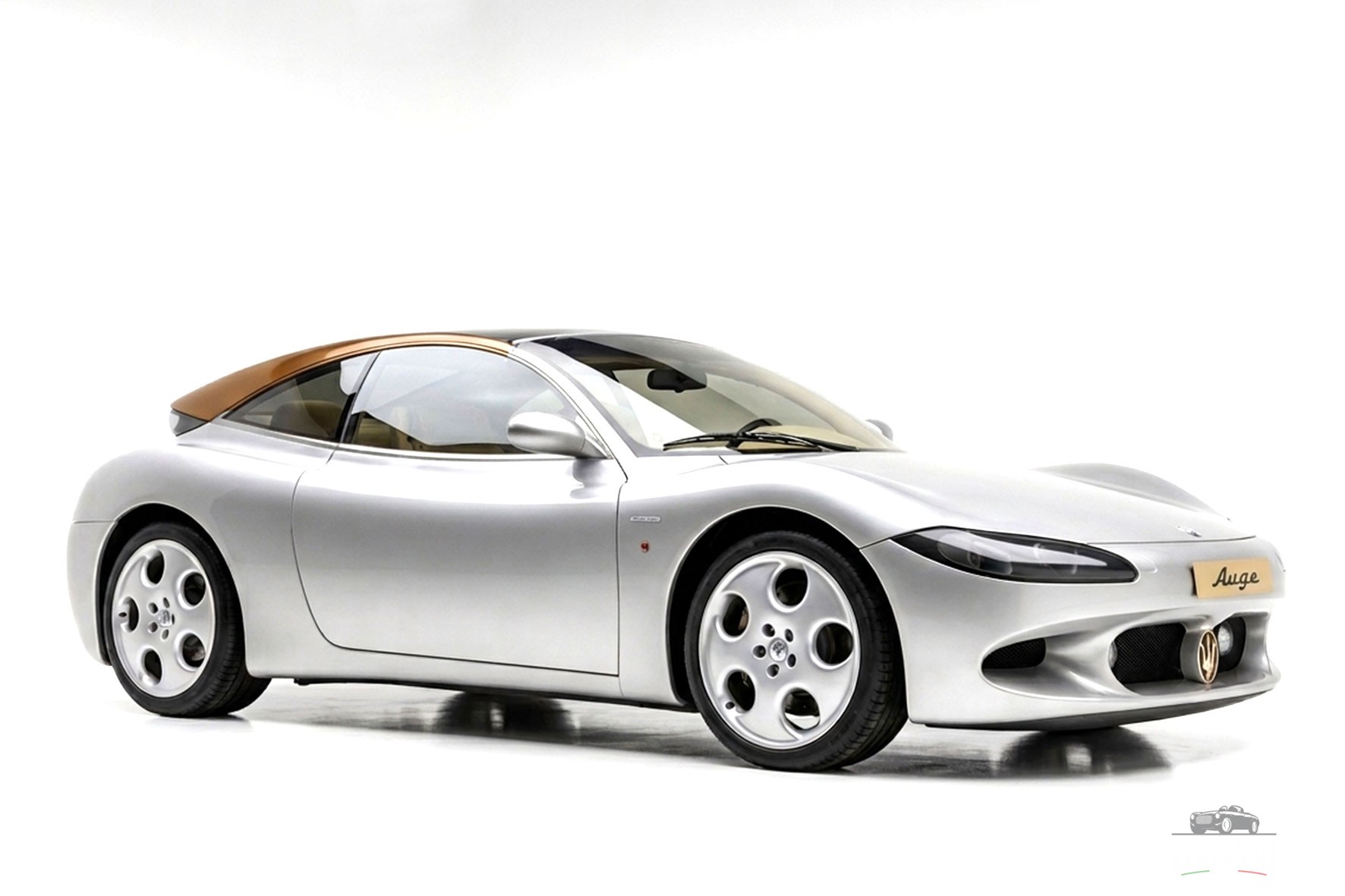
Castagna’s activity around these exhibitions included the Ferrari Rossellini barchetta project and the revised Maserati Auge. Their connection to the G.C. concerns the coachbuilder’s contemporary design programme, not a shared chassis or a succession of bodies on the same physical vehicle. The separate history of the Maserati Auge provides additional context for Castagna’s work in this period. The G.C. has been described as a special or one-off design, but an authenticated build total, complete provenance and identifiable chassis history have not been established.
02 / TECHNICAL IDENTITY
03 / DESIGN, BODY & SUPPLIERS
Coachbuilder / Design studio
The Castagna coachbuilding tradition dates to nineteenth-century Milan, when Carlo Castagna took over an established carriage business. Carrozzeria Castagna later became renowned for luxury bespoke automotive bodies.
Explore record ↗Attributed designer
Gioacchino Acampora was an Italian architect and automotive designer based in Milan.
Explore record ↗04 / CHRONOLOGY
07 / GALLERY
CONTINUE EXPLORING
CONTINUE READING
The Alfa Romeo Vittoria by Castagna wasn’t just another concept — it was a one-off rebirth. Unveiled in 1995, this handmade coupe still sparks debate today.
Read storyThe story of the Maserati Auge by Castagna, a bizarre, fascinating one-off Maserati blending coachbuilding heritage with bold 1990s design.
Read story


THE CONVERSATION
Comments 0