
Aldo Brovarone
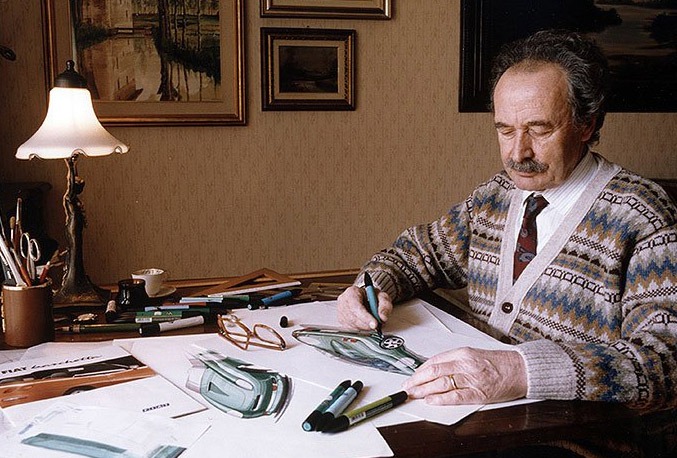
Aldo Brovarone was an Italian automotive stylist associated with Pininfarina, contributing to the Turin firm's post-war tradition of refined sports cars and experimental design.
Explore record ↗
1998Coachwork by Stola
THE VEHICLE AT A GLANCE
THE PEOPLE BEHIND THE CAR
Aldo Brovarone was an Italian automotive stylist associated with Pininfarina, contributing to the Turin firm's post-war tradition of refined sports cars and experimental design.
Explore record ↗Founded in Turin in 1919, Stola became an Italian specialist in automotive prototypes, design studies and low-volume body production for international manufacturers.
Explore record ↗01 / THE STORY
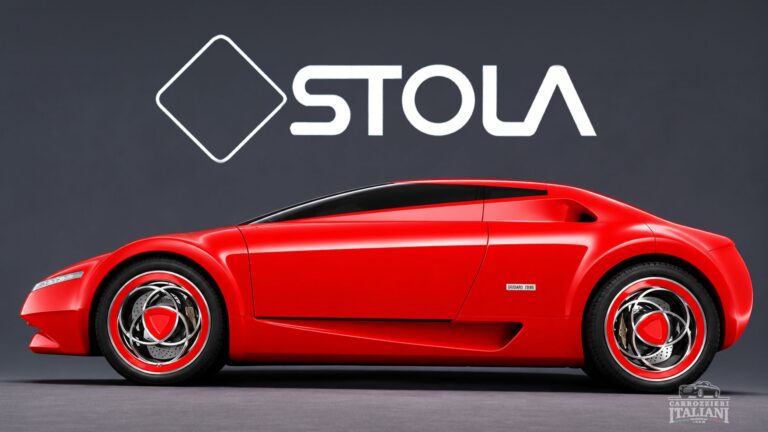
The 1998 Stola Abarth Monotipo 98 is a one-off concept coupé designed by Aldo Brovarone and constructed by Stola in Turin. Developed as a demonstration of Stola’s design-development, prototype-building and composite-manufacturing capabilities, it was presented at the 1998 Turin Motor Show. The Abarth name identified the sporting character of the project; the vehicle was not intended for series production.
The Monotipo was based on the front-wheel-drive architecture of the Fiat Barchetta, but the existing roadster’s open body was replaced by a much wider, low-roofed two-seat coupé. Brovarone developed the exterior in collaboration with Stola’s prototype specialists. The design combined elongated front wings, enclosed headlamp clusters, a low nose, pronounced wheel arches, a glazed roof section and upward-opening doors. Although Brovarone had previously worked at Pininfarina, the Monotipo was a Stola commission rather than a Pininfarina coachbuilding project.
The project followed Stola’s earlier Dedica demonstrator, which had used conventionally formed sheet steel. The Monotipo instead concentrated on composite construction, giving the company a working example of alternative materials and methods. Its development belongs to the larger history of the Turin engineering and prototyping company, described in the site’s Stola company history.
Contemporary material attributed to Stola describes a carbon-fibre composite body made with CIBA Specialty Chemicals resin systems. The programme also included composite modelling and tooling, illustrating how the company could integrate design models, moulds and finished panels within a coordinated development process. Isoclima supplied transparent polycarbonate components, while AG Glasurit was associated with the red paint finish. These were documented project suppliers and should not be confused with the vehicle’s coachbuilder.
The Monotipo was equipped with Brembo ventilated disc brakes, OZ Racing 18-inch wheels and Goodyear Eagle F1 tyres. Momo Corse supplied cockpit equipment. The compact cabin incorporated racing-style seating and controls; the car also featured competition-inspired towing points and air-jacking equipment. The roof glazing and upward-opening doors were integral to the demonstrator’s construction rather than adaptations of the standard Barchetta body.
Its power unit was a front-mounted, turbocharged Lancia-derived four-cylinder engine of 1,995 cc, with sixteen valves and a five-speed manual gearbox driving the front wheels. Stola’s published technical material gave an output of 330 hp at 6,500 rpm, substantially higher than the 260 bhp quoted in some later accounts of the car. The project retained a front-wheel-drive layout with a viscous limited-slip differential. Published dimensions were 4,450 mm in length, 1,880 mm in width and 1,200 mm in height, with a wheelbase of 2,295 mm and a stated weight of 880 kg.
The period technical presentation quoted a maximum speed of 290 km/h and acceleration from rest to 100 km/h in 4.9 seconds. These are published performance claims for the demonstrator, not independently established test results. An archival profile gives a different maximum-speed figure, and the distinction should be retained rather than treating either number as an independently measured result.
The Monotipo was completed for the 1998 Turin exhibition and remained an individual technical demonstrator, not a small-production Abarth road car. Later photographs show the same distinctive red Stola-bodied vehicle in exhibition and collection settings, but publicly available material does not establish a definitive chassis or VIN identification. A chassis number, a chain of ownership or an auction-sale record should therefore be linked only if supported by documents identifying this particular prototype. Brovarone’s broader career and subsequent work can be placed in context through the site’s biographical study.
02 / TECHNICAL IDENTITY
Become a Pro member to see the full details in this section.
Membership is not available yet.
View membership options03 / DESIGN, BODY & SUPPLIERS
Coachbuilder / Design studio
Founded in Turin in 1919, Stola became an Italian specialist in automotive prototypes, design studies and low-volume body production for international manufacturers.
Explore record ↗Designer
Aldo Brovarone was an Italian automotive stylist associated with Pininfarina, contributing to the Turin firm's post-war tradition of refined sports cars and experimental design.
Explore record ↗04 / CHRONOLOGY
07 / GALLERY
CONTINUE READING
Stola: The Art of Making a Car Exist From the wooden patterns of the Lancia Lambda to the extraordinary concept cars of the 1990s, the story of Stola is also the story…
Read storyAldo Brovarone, the humble stylist behind Pininfarina’s greatest icons, from the Ferrari Dino to the Peugeot 504 and Lancia Gamma.
Read storyDiscover the complete history of the Fiat Barchetta, from its unique design and development to rare special editions and prototypes. A detailed look at Fiat’s beloved 1990s roadster.
Read story

THE CONVERSATION
Comments 0