
Beccaris
Founded by Temistocle Beccaris in Turin in the late 1930s, the workshop specialised in sheet-metal craftsmanship, supplying complete bodies and components to other coachbuilders.
Explore record ↗
1962
THE VEHICLE AT A GLANCE
THE PEOPLE BEHIND THE CAR
Founded by Temistocle Beccaris in Turin in the late 1930s, the workshop specialised in sheet-metal craftsmanship, supplying complete bodies and components to other coachbuilders.
Explore record ↗PRICE & SALES RECORD
01 / THE STORY
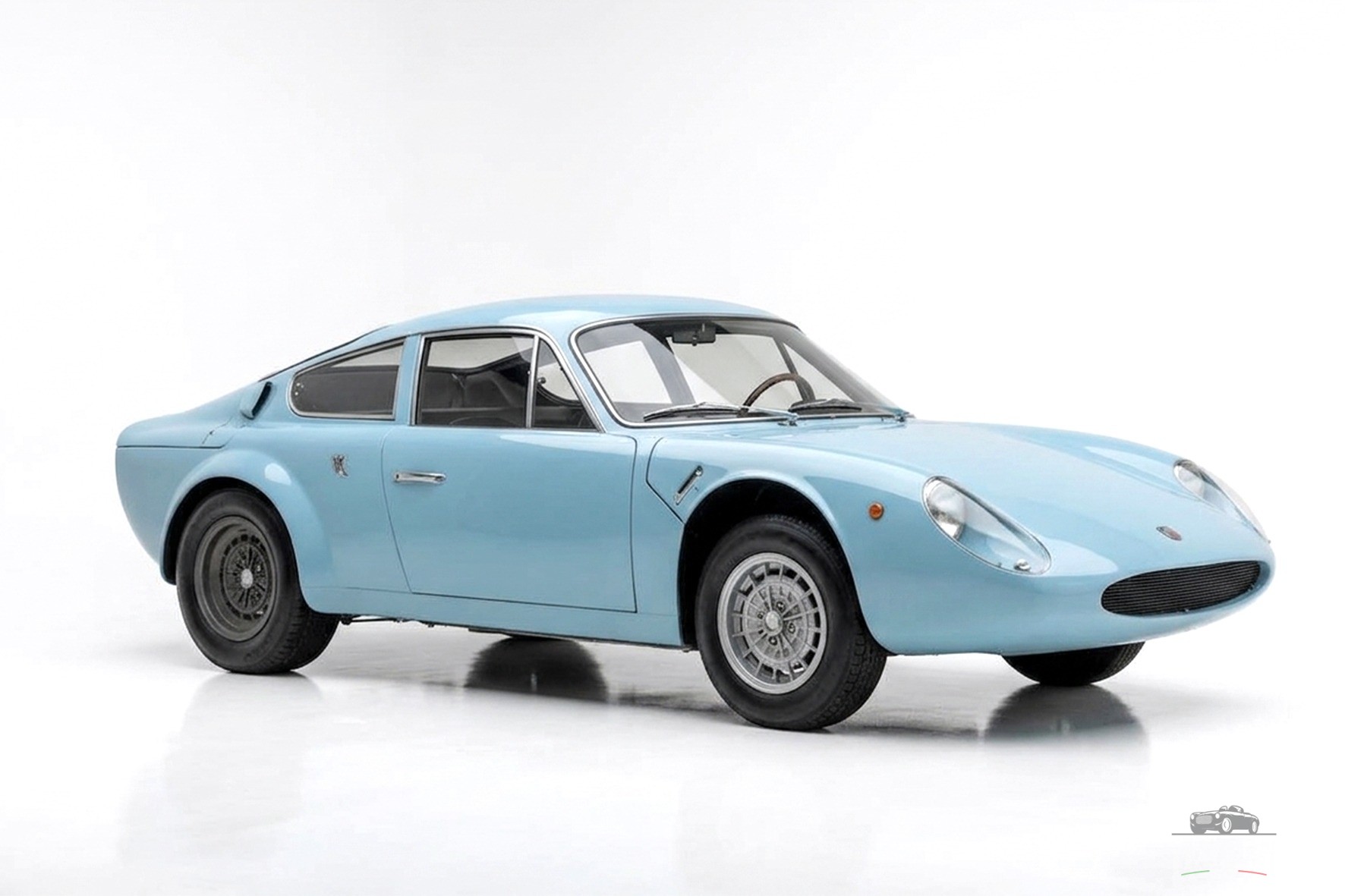
The Abarth-Simca 1300 GT was a rear-engined competition coupé introduced in 1962 by Abarth in collaboration with the French manufacturer Simca. It combined mechanical components derived from the Simca 1000 with Abarth’s twin-cam four-cylinder engine, a shortened and modified chassis, and lightweight sporting coachwork. The programme developed through several body configurations and suppliers between 1962 and the mid-1960s. This entry describes the model family, not an individual chassis.
The collaboration gave Simca a specialised grand touring competition car while Abarth gained access to the Simca 1000’s rear-engined platform and selected transmission, steering and suspension components. Abarth undertook substantial mechanical and structural development rather than simply modifying a standard production coupé. Engineer Mario Colucci played an important role in the programme’s body design and competition development. The short-wheelbase architecture and compact coupé body were adapted repeatedly as the racing specification evolved.
Coachbuilding attribution requires particular care. Abarth’s own 1962 factory newsletter describes the body of the launch-period example it illustrated as built by Abarth & C. Other early competition bodies are documented as the work of Beccaris, while Sibona & Basano became another supplier of limited-series bodywork. Specialist research indicates that Beccaris and Sibona & Basano activities overlapped during later development, rather than following one simple and universal handover. Neither a model year nor a particular tail or nose treatment is sufficient to assign a surviving car to one workshop.
The original 1300 programme used an approximately 1,288 cc Abarth Bialbero inline-four engine, with twin overhead camshafts and a rear-wheel-drive layout. Early specifications describe a four-speed transaxle with Simca origins; later competition cars could receive revised transmissions, induction systems and engine configurations. Period figures for power, weight and maximum speed differ according to build date, homologation category and racing preparation. They should not be presented as universal specifications for all cars carrying the 1300 GT name.
Successive round-tail, long-nose and truncated-tail configurations reflect aerodynamic and competition development, but the terminology applied retrospectively by historians and auction catalogues is not always consistent. Construction methods and body details similarly varied. The related Abarth-Simca 2000 GT Corsa belongs to the subsequent larger-engined branch of this programme and must not be counted as a 1300 GT chassis.
The 1300 GT appeared in international grand touring competition soon after its introduction. Historical racing documentation reproduced by Abarth specialists identifies four 1,288 cc Simca-Abarth coupés among the 1962 Le Mans entries. Later examples competed in Italian hill climbs and circuit events. Individual results should be linked to the specific car and event, rather than awarded indiscriminately to the model family.
Several surviving chassis have distinct published histories. The early Series I car identified in a specialist market account as 130S*0054* is associated with a round-tail configuration, although its physical chassis stamping was not independently confirmed in that account. Chassis 0128 is separately identified in historical research as a later Series III or Kamm-tail example, with a documented restoration history. The 1963 car catalogued as 130S-0091 has an unusually complex history involving a possible later replacement body, and another car has been associated with the same numerical designation. These identities should remain separate until the original serials, body numbers and documentary chains can be reconciled.
The programme also illustrates the division between Abarth’s engineering organisation and external body suppliers within Turin’s specialist motor industry. Further context on the work of one of those suppliers appears in the site’s history of Sibona & Basano.
02 / TECHNICAL IDENTITY
03 / DESIGN, BODY & SUPPLIERS
Coachbuilder / Design studio
Founded by Temistocle Beccaris in Turin in the late 1930s, the workshop specialised in sheet-metal craftsmanship, supplying complete bodies and components to other coachbuilders.
Explore record ↗04 / CHRONOLOGY
05 / MARKET & PRICE HISTORY
USD · 1 recorded sale
Includes recorded sales pending source verification.
RECORDED SALES
USD
Each point is a completed sale with its own date, in chronological order. Dates are positioned by calendar time, with approximate placement when only a year or month is documented. The connecting line shows observed sales prices in this currency, not an appreciation index: transactions may concern different chassis and specifications. Factory prices and unsold estimates are excluded.
Sign in to see the details of each sale on the chart.
Become a Pro member to explore the full price and sale history.
Membership is not available yet.
View membership optionsMarket observations describe documented transactions, estimates or offers. They are not themselves a current valuation of the vehicle.
06 / CHASSIS REGISTER
07 / GALLERY
THE CONVERSATION
Comments 0