
Zagato
Founded in Milan in 1919 by Ugo Zagato, the coachbuilding house developed lightweight aerodynamic bodies inspired by aircraft construction, creating distinctive racing and grand touring automobiles.
Explore record ↗
1931Coachwork by Zagato
THE VEHICLE AT A GLANCE
THE PEOPLE BEHIND THE CAR
Founded in Milan in 1919 by Ugo Zagato, the coachbuilding house developed lightweight aerodynamic bodies inspired by aircraft construction, creating distinctive racing and grand touring automobiles.
Explore record ↗01 / THE STORY
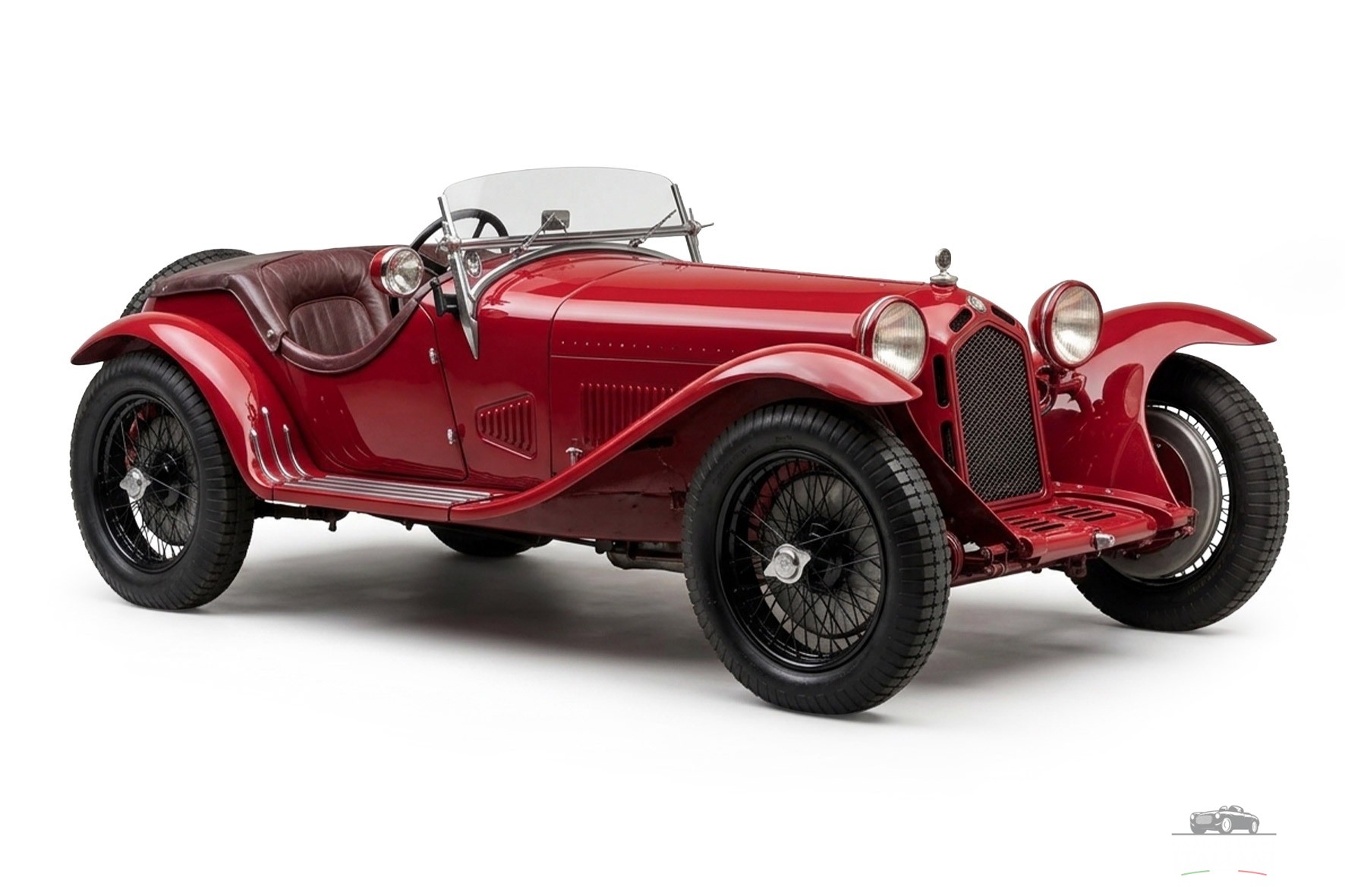
Alfa Romeo introduced the 8C 2300 in 1931, using a supercharged straight-eight engine developed under Vittorio Jano. Short-chassis competition Spiders were prepared by Alfa Corse and Scuderia Ferrari, with bodies and body alterations supplied by specialist Italian coachbuilders, including Zagato. The designation Monza followed Alfa Romeo’s victory in the 1931 Italian Grand Prix. Individual cars could acquire Monza-type mechanical and body modifications during their racing careers rather than leaving the factory in an identical configuration.
One documented first-series short-chassis car associated with the Zagato-bodied group is chassis 2111006. It began life in 1931 with a minimal bacquet-style competition body for Alfa Romeo’s racing operation. On 12 July 1931, Ferdinando Minoia and Giovanni Minozzi finished third in the Belgian Grand Prix in this chassis. Scuderia Ferrari acquired the car on 29 July, and Tazio Nuvolari won the Coppa Ciano on 2 August. During this period its registration was MO 5201 and it carried a Monza-style radiator treatment.
During the winter of 1931–1932 the car received further competition modifications, including changes to its chassis and bodywork. It entered the 1932 Mille Miglia as number 82 with Pietro Ghersi and Giulio Ramponi, retiring before Florence. Antonio Brivio drove the same car in the 1932 Targa Florio, where brake problems caused its retirement. Ghersi subsequently won the Coppa Messina in May 1932. A proposed connection between this chassis and the 1933 Mille Miglia has not been established, and no result from that edition is assigned to the car.
In 1933 the 8C was acquired by Giuseppe de Filippis and registered in Rome as 35072. Pietro Santi and Lelio Pellegrini entered chassis 2111006 in the 1934 Mille Miglia as number 54, but did not finish. By July 1936 it was photographed with the Zagato Spider body that became part of its subsequent history. Paul Decker registered the car in Luxembourg as 13217 on 27 August 1936. It later passed through Belgium and, in 1956, to the United States. During Rodney Felton’s ownership in Britain, a separate Monza-type body was made for competition so that the period Spider body could be preserved.
The chassis passed to Bruce Vanyo in 1992, to Alain de Cadenet in 1994, and subsequently entered Eric Heerema’s collection in 1996. It appeared in the Cartier Style et Luxe presentation at the 2015 Goodwood Festival of Speed. Between 2019 and 2024 Jim Stokes Workshops restored chassis 2111006 to an earlier racing configuration, removing and preserving its period Zagato Spider body and fitting a newly constructed bacquet body and a replacement competition engine while retaining the original components. It returned to the modern Mille Miglia in 2023 and appeared in the Alfa Romeo celebration at the 2025 Goodwood Revival.
02 / TECHNICAL IDENTITY
03 / DESIGN, BODY & SUPPLIERS
Coachbuilder / Design studio
Founded in Milan in 1919 by Ugo Zagato, the coachbuilding house developed lightweight aerodynamic bodies inspired by aircraft construction, creating distinctive racing and grand touring automobiles.
Explore record ↗04 / CHRONOLOGY
05 / PEOPLE, COLLECTIONS & MUSEUMS
07 / CHASSIS REGISTER
08 / GALLERY
THE CONVERSATION
Comments 0