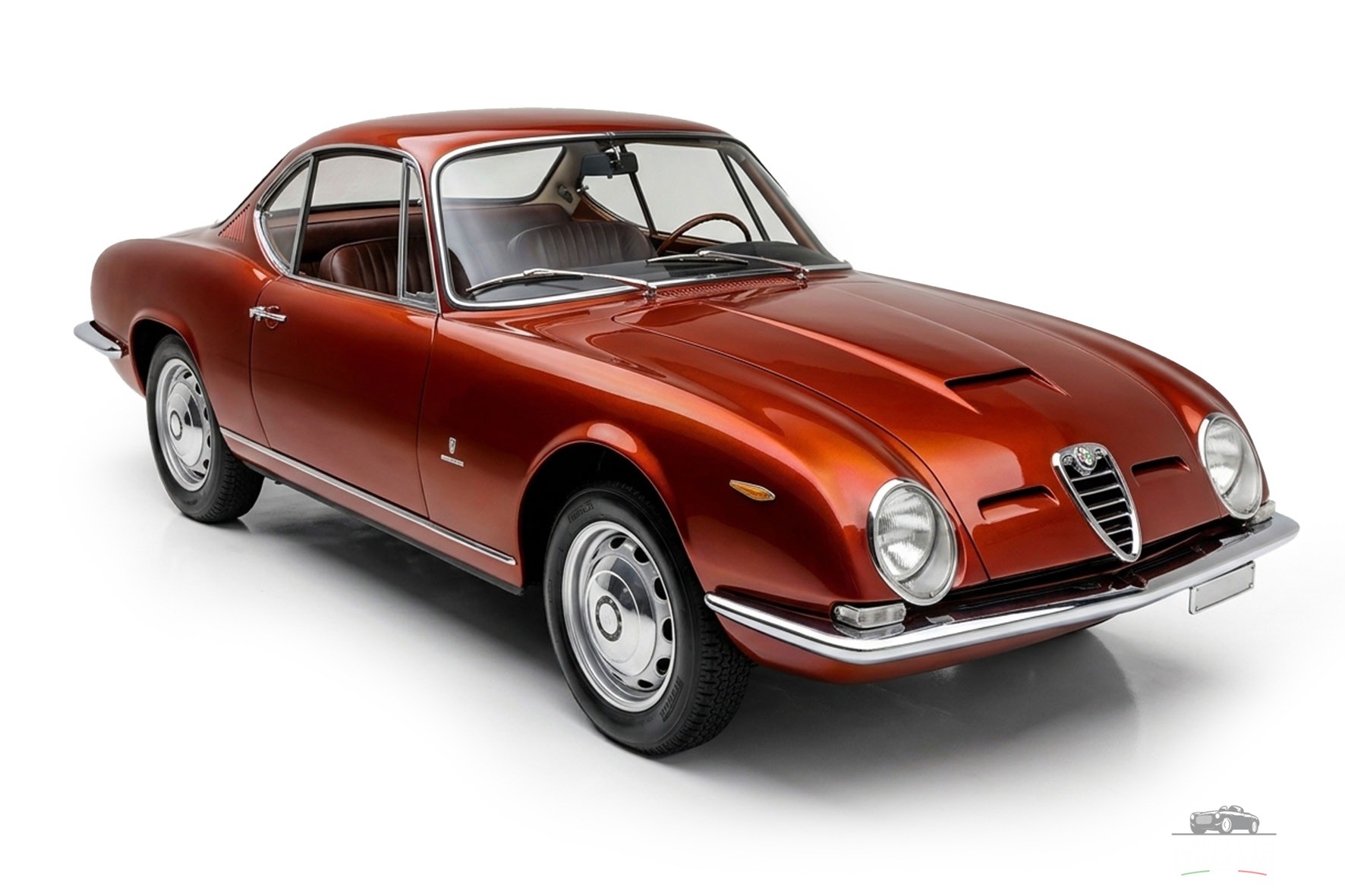
The 1963 Alfa Romeo 2600 Sprint HS, also known as the High Speed coupé, was a one-off design study by Carrozzeria Bertone and Giorgetto Giugiaro. Giugiaro’s official project archive identifies it as a more radical interpretation of the six-cylinder Alfa Romeo Tipo 106 and explicitly distinguishes it from the production Sprint. Bertone’s historical account, republished in 2010, likewise dates the HS to 1963 and records it as a unique creation rather than a series-production model.
From the 2600 Sprint to a two-seat concept
The basis for the exercise was the Alfa Romeo 2600 range, which replaced the earlier 2000 in 1962. The regular 2600 Sprint retained much of the four-seat grand tourer’s body language, originally developed by Giugiaro for Bertone’s 2000 Sprint. The HS was conceived as a more compact-looking, two-seat sporting coupé. Instead of reproducing the standard Sprint’s broad four-headlamp grille, its front was reinterpreted with two large round headlights, a lower bonnet profile and a more restrained treatment of the Alfa Romeo shield. Period photographs show a closely integrated roof, glazed cabin and simple flanks, illustrating an alternative direction within Bertone’s early-1960s Alfa Romeo work.
A separate branch of Bertone’s experiments
In its retrospective history of Alfa Romeo designs, Bertone places the 2600 Sprint HS alongside another one-off Giulia Sprint Speciale project developed in 1963. These are separate cars, not two names for the same prototype. Bertone subsequently used an Alfa Romeo Giulia TZ chassis for the Alfa Romeo Canguro of 1964; the Canguro’s chassis and body should not be assigned to the earlier HS. The contemporary Chevrolet Corvair Testudo, also designed at Bertone, pursued a different, more experimental body concept. The proximity of these projects in the studio’s chronology is historically relevant, but does not establish shared components or a direct development sequence.
Documentation and technical scope
Giugiaro’s archive identifies the HS with the Tipo 106 six-cylinder Alfa Romeo programme, while the surviving manufacturer information for the normal 2600 Sprint describes a 2,584 cc twin-cam six-cylinder engine and a five-speed gearbox. Those production specifications provide context but cannot automatically be treated as an exact technical record for the one-off HS. The vehicle’s individual chassis number, engine serial, dimensions, later ownership and restoration history remain unconfirmed in the material reviewed. A legacy reference associates the car with Geneva in 1963, but the precise exhibition entry requires independent verification against period show records. Likewise, documented auction transactions for ordinary 2600 Sprints are not sales of the HS unless the unique vehicle can be identified independently.



THE CONVERSATION
Comments 0