
Pininfarina
Founded by Battista Pinin Farina in Turin in 1930, Pininfarina became one of the most influential Italian styling and coachbuilding houses, particularly through its work for Ferrari and other international manufacturers.
Explore record ↗
1997Coachwork by Pininfarina
THE VEHICLE AT A GLANCE
THE PEOPLE BEHIND THE CAR
Founded by Battista Pinin Farina in Turin in 1930, Pininfarina became one of the most influential Italian styling and coachbuilding houses, particularly through its work for Ferrari and other international manufacturers.
Explore record ↗01 / THE STORY
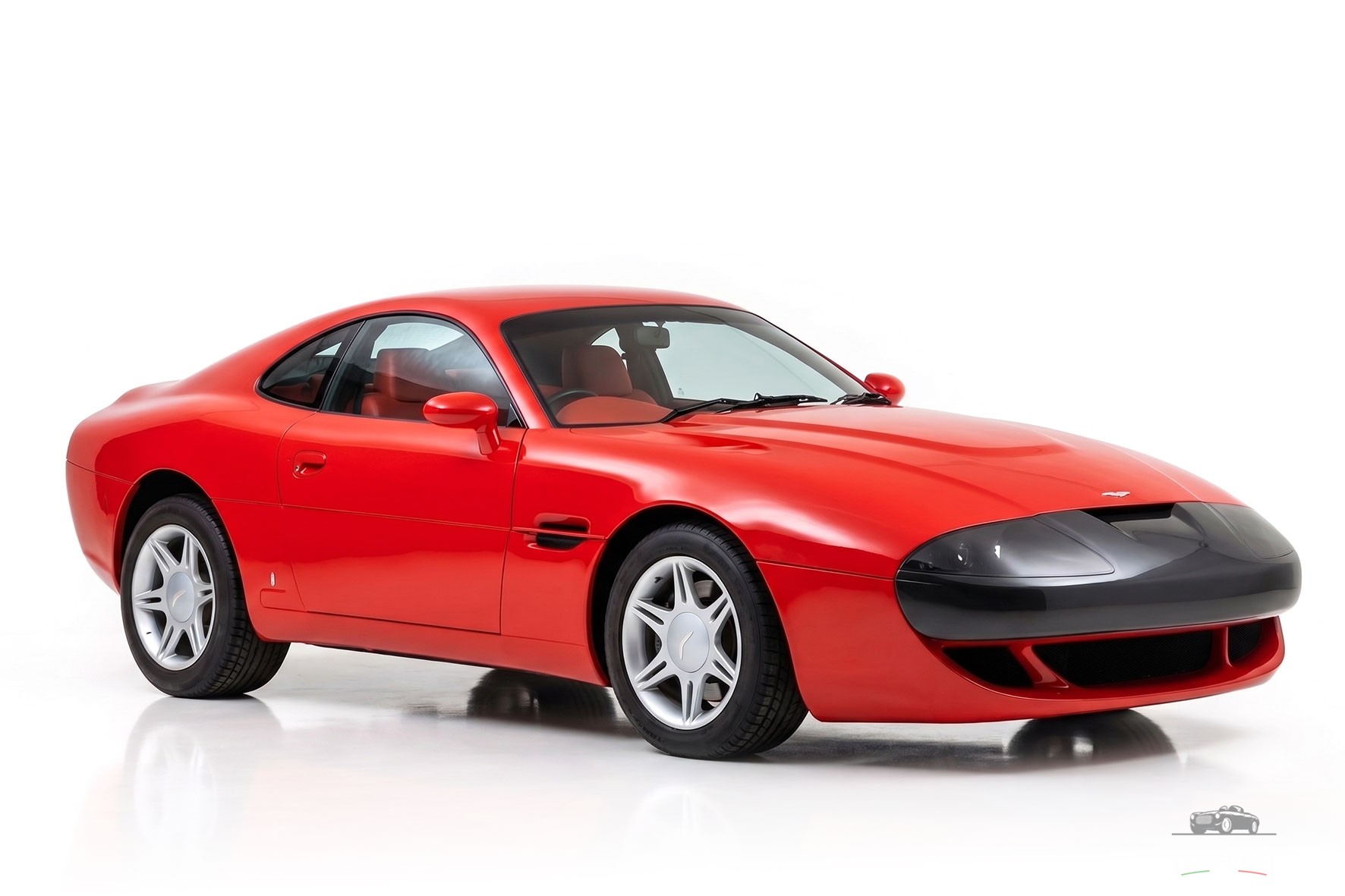
The Aston Martin AM3 was a bespoke 2+2 coupé created for the Sultan of Brunei and designed by Scott A. Barras at Pininfarina Studi e Ricerchi in 1995. The project originated when the client requested that Pininfarina approach Aston Martin with a proposal for a series of unique cars based on Vantage mechanicals. Aston Martin supplied unnumbered rolling and running Vantage 600 chassis, each fitted with the upgraded 600 bhp twin-supercharged 5.3-litre V8, the Torqueflite four-speed-plus-overdrive automatic transmission with a 3.31:1 final drive, and the full Vantage brake and suspension package. These chassis were delivered to Coggiola near Turin, where the aluminium bodies and interiors specified by Pininfarina were constructed. Five design studies, designated AM1 through AM5, were submitted to the client; only AM3 and AM4 proceeded to production, leaving AM1, AM2, and AM5 unpublicised. AM3 adopted the most radical aesthetic interpretation of any of the Special Series vehicles produced for this client. Its form deviated from recognised Aston Martin design language, replacing the conventional frontal treatment with a composite detachable nose cone integrating the lights and a recessed intake, a feature that produced visual associations with rubber-bumpered British sports cars or American models fitted with protective “bra” coverings. The rear used a smoked black panel shaped in the outline of the traditional Aston Martin grille, concealing the tail lamps and flaring into a Kamm tail above dual circular exhaust outlets. The side vents behind the front wheels were the only exterior features that retained a direct connection to Aston Martin production models. The car rode on unique six-spoke alloy wheels with Goodyear Eagle 285/45 ZR18 tyres and carried both Pininfarina and Aston Martin identification. The body’s proportions produced a sleeker and more contemporary silhouette than the AM4, which drew on the muscular volumes of earlier DB5 and DB6 models. AM3 instead used more tapered extremities and a modern interpretation of the classic Aston Martin grille form to define its overall character. Although never formally shown to the public, the model was reproduced in 1/43 scale by Ban Seng, marking one of the few acknowledgments of its existence. Internally, the AM3 featured a complete Pininfarina-designed cabin distinct from any Aston Martin interior of the period. The dashboard placed all primary instruments in a single horizontal line directly ahead of the driver. Most switchgear and trim components were unique to the project, though the steering wheel, sourced from Ford, was shared with other Aston Martin models. The seating layout provided limited rear accommodation but was executed to a high standard with bespoke materials and surface finishes. The car retained the structural foundation of the Vantage chassis, using a steel box-section frame with a steel superstructure. Suspension comprised independent front wishbones with Eibach coil springs, coaxial spring-dampers and an anti-roll bar, and a rear De Dion axle with radius arms, a Watt’s linkage, Eibach coil springs, telescopic dampers and an anti-roll bar. Braking was provided by servo-assisted 365 mm grooved and ventilated front discs with AP Racing six-piston calipers and 310 mm ventilated rear discs with AP Racing four-piston calipers, supported by ABS. Power steering was delivered through a rack-and-pinion system. Performance remained consistent with the Vantage specification, with approximately 600 bhp at 6,500 rpm and 600 lb ft of torque at 4,000 rpm, producing a reported maximum speed near 205 mph. The AM3 measured approximately 15 ft 7 in in length, 6 ft 4 in in width excluding mirrors, 4 ft 4½ in in height, and 8 ft 6½ in in wheelbase, with a kerb weight of about 4,300 lb. Three examples were constructed between 1996 and 1997, bodied by Coggiola and shipped directly to the Sultan of Brunei’s collection.
02 / TECHNICAL IDENTITY
Become a Pro member to see the full details in this section.
Membership is not available yet.
View membership options03 / DESIGN, BODY & SUPPLIERS
Coachbuilder / Design studio
Founded by Battista Pinin Farina in Turin in 1930, Pininfarina became one of the most influential Italian styling and coachbuilding houses, particularly through its work for Ferrari and other international manufacturers.
Explore record ↗Attributed designer
Prototype builder
Founded in Turin in 1966 by Sergio Coggiola after his work at Ghia, Carrozzeria Coggiola built specialist automotive bodies and design prototypes, including projects for Saab.
Explore record ↗05 / PEOPLE, COLLECTIONS & MUSEUMS
07 / CHASSIS REGISTER
08 / GALLERY
THE CONVERSATION
Comments 0