
Pininfarina
Founded by Battista Pinin Farina in Turin in 1930, Pininfarina became one of the most influential Italian styling and coachbuilding houses, particularly through its work for Ferrari and other international manufacturers.
Explore record ↗
1987
THE VEHICLE AT A GLANCE
THE PEOPLE BEHIND THE CAR
Founded by Battista Pinin Farina in Turin in 1930, Pininfarina became one of the most influential Italian styling and coachbuilding houses, particularly through its work for Ferrari and other international manufacturers.
Explore record ↗Leonardo Fioravanti is an Italian automotive designer renowned for his work at Pininfarina, where he contributed to the styling of landmark Ferrari road cars.
Explore record ↗PRICE & SALES RECORD
01 / THE STORY
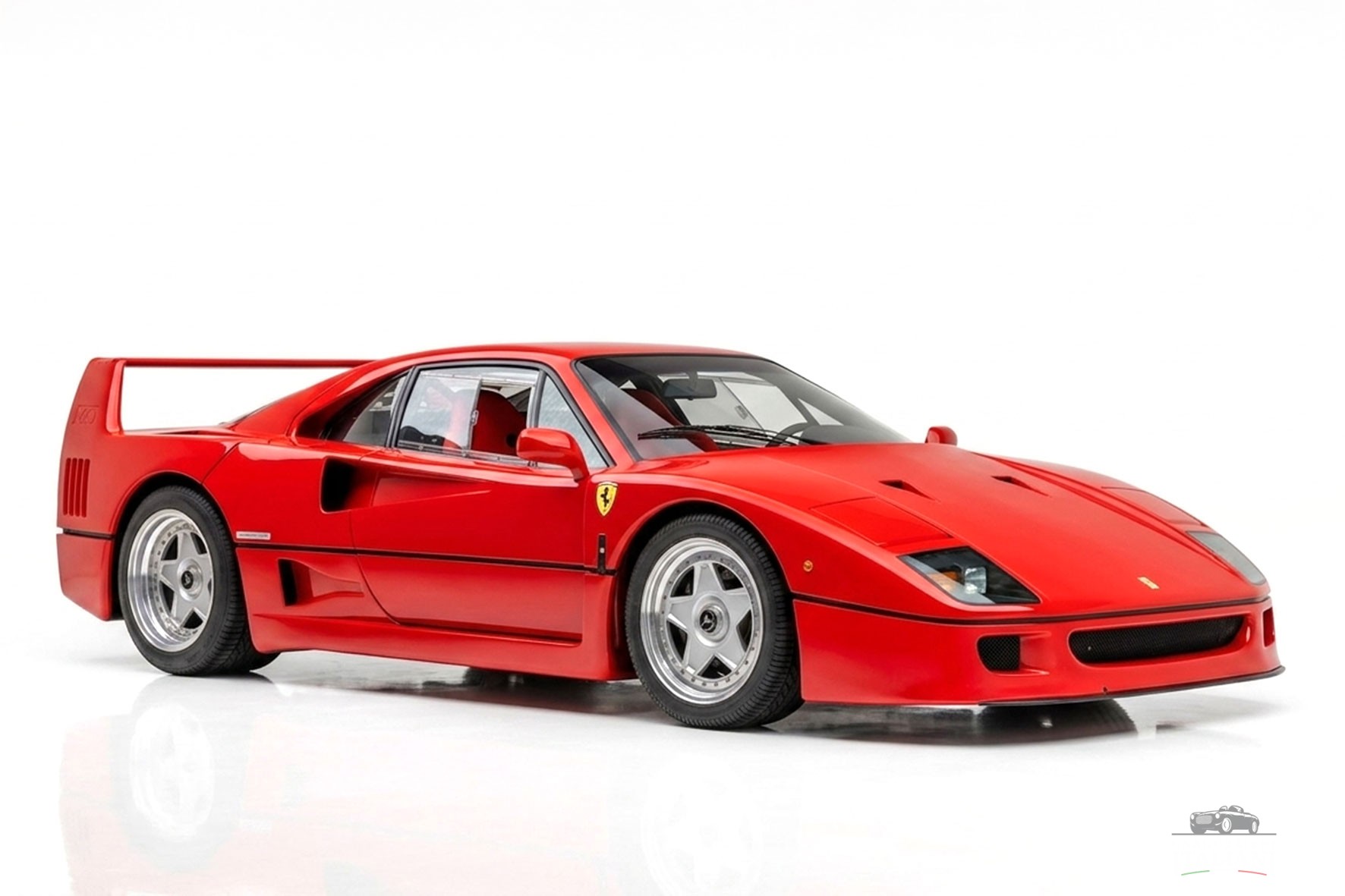
Ferrari F40 debuted in 1987 with a planned production total of 400 cars and a factory suggested retail price of about US$400,000. Production ultimately reached 1,315 cars, including 213 intended for the United States. One F40 owned by Formula One driver Nigel Mansell sold for £1 million in 1990, setting a record that remained in place into the 2010s. The programme grew from work begun in 1984, when Nicola Materazzi proposed to Enzo Ferrari that the FIA Group B four-litre category—2.857 litres for turbocharged engines—could demonstrate the performance of new road cars. Materazzi had to secure approval from general manager Eugenio Alzati because Enzo Ferrari no longer controlled the production side of the business. Alzati permitted the work on the condition that it took place outside the Monday-to-Friday working week. A small group developed the 288 GTO Evoluzione on Saturdays for the same FIA Group B class entered by the Porsche 959. The FIA ended Group B for the 1986 season, leaving Ferrari with five 288 GTO Evoluzione development cars and no championship in which to race them. A validation driver persuaded Enzo Ferrari that Materazzi could retain the base concept and make it suitable for road use. Enzo Ferrari then authorised further development as a road-only car. On 10 June 1986, he instructed the team to complete it within 11 months for presentation in the summer of 1987, and allowed Materazzi to select the engineers working on the project. The F40 retained many styling cues from the 288 GTO Evoluzione. Leonardo Fioravanti and Pietro Camardella designed the body at Pininfarina, under Materazzi’s guidance. Materazzi developed the engine, gearbox and other mechanical components for road use, drawing on parts already validated through the Evoluzione programme. External specialists also undertook portions of the development. Michelotto Automobili in Padua carried out bodywork development, bringing its rally and race-preparation experience to the work. Ferrari’s marketing department presented the F40 as “very fast, sporting in the extreme and Spartan.” The same statement answered customers who considered Ferrari road cars increasingly plush and comfortable, and described the model as intended for owners seeking sheer performance rather than as a laboratory for future technology. Its simplicity and raw character reflected Materazzi’s racing background. The expanded production run rose well beyond the original 400-car plan, reaching 1,315 examples.
02 / TECHNICAL IDENTITY
03 / DESIGN, BODY & SUPPLIERS
Coachbuilder / Design studio
Founded by Battista Pinin Farina in Turin in 1930, Pininfarina became one of the most influential Italian styling and coachbuilding houses, particularly through its work for Ferrari and other international manufacturers.
Explore record ↗Designer
Leonardo Fioravanti is an Italian automotive designer renowned for his work at Pininfarina, where he contributed to the styling of landmark Ferrari road cars.
Explore record ↗04 / CHRONOLOGY
05 / PEOPLE, COLLECTIONS & MUSEUMS
06 / MARKET & PRICE HISTORY
USD · 3 recorded sales
RECORDED SALES
USD
Each point is a completed sale with its own date, in chronological order. Dates are positioned by calendar time, with approximate placement when only a year or month is documented. The connecting line shows observed sales prices in this currency, not an appreciation index: transactions may concern different chassis and specifications. Factory prices and unsold estimates are excluded.
CHF · 1 recorded sale
Includes recorded sales pending source verification.
RECORDED SALES
CHF
Each point is a completed sale with its own date, in chronological order. Dates are positioned by calendar time, with approximate placement when only a year or month is documented. The connecting line shows observed sales prices in this currency, not an appreciation index: transactions may concern different chassis and specifications. Factory prices and unsold estimates are excluded.
EUR · 1 recorded sale
Includes recorded sales pending source verification.
RECORDED SALES
EUR
Each point is a completed sale with its own date, in chronological order. Dates are positioned by calendar time, with approximate placement when only a year or month is documented. The connecting line shows observed sales prices in this currency, not an appreciation index: transactions may concern different chassis and specifications. Factory prices and unsold estimates are excluded.
Sign in to see the details of each sale on the chart.
Become a Pro member to explore the full price and sale history.
Membership is not available yet.
View membership optionsMarket observations describe documented transactions, estimates or offers. They are not themselves a current valuation of the vehicle.
07 / CHASSIS REGISTER
8 chassis numbers in the register
1 recorded sale · 2025
1 recorded sale · 2025
View full chassis register · Pro membership
08 / GALLERY
THE CONVERSATION
Comments 0