
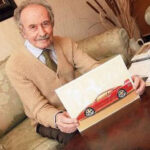
Aldo Brovarone
Aldo Brovarone was an Italian automotive stylist associated with Pininfarina, contributing to the Turin firm's post-war tradition of refined sports cars and experimental design.
Explore record ↗
1953Coachwork by Pininfarina
THE VEHICLE AT A GLANCE
THE PEOPLE BEHIND THE CAR
Aldo Brovarone was an Italian automotive stylist associated with Pininfarina, contributing to the Turin firm's post-war tradition of refined sports cars and experimental design.
Explore record ↗Founded by Battista Pinin Farina in Turin in 1930, Pininfarina became one of the most influential Italian styling and coachbuilding houses, particularly through its work for Ferrari and other international manufacturers.
Explore record ↗01 / THE STORY
The Maserati A6GCS Berlinetta by Pininfarina was unveiled at the 1954 Turin Motor Show. The model was derived from the A6GCS/53 2000 Sport, Maserati’s open two-seater competition car designed for endurance events such as the Mille Miglia. Following the 1952 edition of the race, which was run under heavy rain, several Maserati clients requested a closed berlinetta body for improved protection and aerodynamics. Maserati itself could not commission Pininfarina directly, as the Turin coachbuilder was under exclusive contract with Ferrari. Rome-based Maserati dealer Guglielmo “Mimmo” Dei purchased six bare A6GCS/53 chassis and commissioned Pininfarina to construct enclosed bodies for them. Aldo Brovarone, working under Battista “Pinin” Farina, designed the berlinetta body. The result was a compact, aerodynamically efficient coupe with smooth proportions, short overhangs, and a fastback profile. The front featured a large oval grille with the Maserati trident, integrated fenders, and a low, tapered hood. The chassis retained its original tubular steel space-frame construction with a wheelbase of 2,310 mm. Suspension used double wishbones with coil springs at the front and a live rear axle with leaf springs. Drum brakes were fitted on all four wheels. The front-mounted 1,985.6 cc inline-six engine featured twin overhead camshafts and three Weber carburetors, producing 170 hp at 7,300 rpm. Power was transmitted through a four-speed manual gearbox to the rear wheels. Top speed was approximately 235 km/h, and the kerb weight was around 740 kg. Of the six chassis acquired by Dei, four were completed by Pininfarina as berlinettas: chassis numbers 2056, 2057, 2059, and 2060. One of these was displayed at the 1954 Turin Motor Show, causing tension with Ferrari due to Pininfarina’s involvement. All four examples survive today and are regarded as among the most significant Maseratis ever produced. Chassis 2056 is part of the Umberto Panini Collection.
02 / TECHNICAL IDENTITY
Become a Pro member to see the full details in this section.
Membership is not available yet.
View membership options03 / DESIGN, BODY & SUPPLIERS
Coachbuilder / Design studio
Founded by Battista Pinin Farina in Turin in 1930, Pininfarina became one of the most influential Italian styling and coachbuilding houses, particularly through its work for Ferrari and other international manufacturers.
Explore record ↗Designer
Aldo Brovarone was an Italian automotive stylist associated with Pininfarina, contributing to the Turin firm's post-war tradition of refined sports cars and experimental design.
Explore record ↗04 / CHRONOLOGY
05 / PEOPLE, COLLECTIONS & MUSEUMS
07 / CHASSIS REGISTER
6 chassis numbers in the register
View full chassis register · Pro membership
08 / GALLERY

THE CONVERSATION
Comments 0