
Pininfarina
Founded by Battista Pinin Farina in Turin in 1930, Pininfarina became one of the most influential Italian styling and coachbuilding houses, particularly through its work for Ferrari and other international manufacturers.
Explore record ↗
1997Coachwork by Pininfarina
THE VEHICLE AT A GLANCE
THE PEOPLE BEHIND THE CAR
Founded by Battista Pinin Farina in Turin in 1930, Pininfarina became one of the most influential Italian styling and coachbuilding houses, particularly through its work for Ferrari and other international manufacturers.
Explore record ↗01 / THE STORY
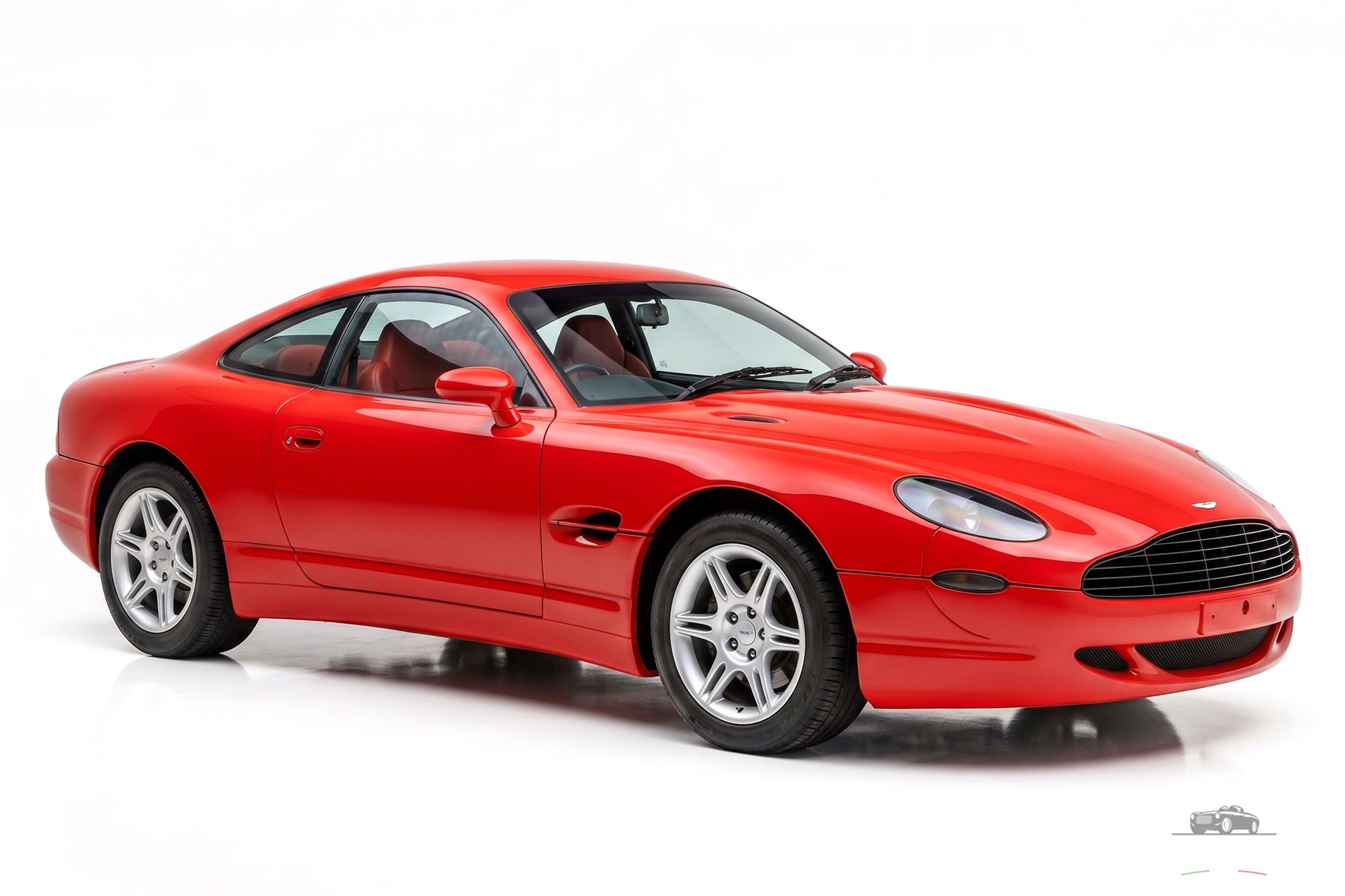
The Aston Martin AM4 was a bespoke 2+2 coupé designed by Scott A. Barras at Pininfarina Studi e Ricerchi for the Sultan of Brunei. Conceived in 1995 and completed in early 1998, the model was developed on an unnumbered Aston Martin Vantage 600 rolling chassis supplied directly to Pininfarina. The aluminium bodywork, built by Coggiola in Turin, combined proportions associated with traditional Aston Martin grand tourers with Pininfarina’s own design language. The exterior incorporated an elongated five-slat grille, DB7-type headlamps, bonnet air outlets, and pronounced side sculpting with six-spoke alloy wheels shared with the earlier AM3 commission. At the rear, an inverted interpretation of the Aston Martin grille was integrated into the light cluster above dual rectangular exhaust outlets, creating a profile that referenced the DB5 and DB6 while diverging from contemporary production practice. The interior was designed entirely by Pininfarina and bore little resemblance to any standard Aston Martin cabin. Although the Vantage steering wheel with airbag was retained, the dashboard, switchgear, seating, and door trims were newly created. The cabin used flowing, organically curved forms rather than the linear layout of Aston Martin production models, with instruments arranged in a straight horizontal line across the right side of the dashboard. Glossy colour-coded finishes were applied to the steering wheel, transmission tunnel, centre console, and door panels. Despite the use of an Aston Martin trim buck during development, the resulting interior was unique to the AM4 and independent of factory design conventions. Structurally, the car employed a steel box-section chassis with a steel superstructure. The suspension consisted of independent front wishbones with Eibach coil springs, coaxial dampers, and an anti-roll bar, and a rear De Dion axle with radius arms, a Watt’s linkage, Eibach coil springs, telescopic dampers, and an anti-roll bar. The braking system used servo-assisted 365 mm ventilated front discs with AP Racing six-piston calipers and 310 mm ventilated rear discs with AP Racing four-piston calipers, supported by ABS. Power steering was provided by a rack-and-pinion system. The AM4 ran on 18-inch alloy wheels fitted with Goodyear Eagle 285/45 ZR18 tyres. Power was supplied by Aston Martin’s 5.3-litre all-alloy V8 equipped with twin Eaton superchargers, twin overhead camshafts per bank, four valves per cylinder, additional intercooler radiators, and a fully catalysed exhaust system. With an 8.2:1 compression ratio, the engine produced approximately 600 bhp at 6,500 rpm and 600 lb ft of torque at 4,000 rpm. A Torqueflite four-speed-plus-overdrive automatic transmission with a 3.11:1 final drive and limited-slip differential delivered power to the rear axle. The car achieved an estimated top speed of 205 mph. Dimensions included a length of approximately 15 ft 7 in, a width of 6 ft 4 in excluding mirrors, a height of 4 ft 4½ in, an 8 ft 6½ in wheelbase, and a kerb weight of roughly 4,300 lb. Three examples were produced to the specification of the Sultan of Brunei and delivered directly to his private automotive collection.
02 / TECHNICAL IDENTITY
Become a Pro member to see the full details in this section.
Membership is not available yet.
View membership options03 / DESIGN, BODY & SUPPLIERS
Coachbuilder / Design studio
Founded by Battista Pinin Farina in Turin in 1930, Pininfarina became one of the most influential Italian styling and coachbuilding houses, particularly through its work for Ferrari and other international manufacturers.
Explore record ↗Attributed designer
Prototype builder
Founded in Turin in 1966 by Sergio Coggiola after his work at Ghia, Carrozzeria Coggiola built specialist automotive bodies and design prototypes, including projects for Saab.
Explore record ↗Become a Pro member to see the full details in this section.
Membership is not available yet.
View membership options05 / PEOPLE, COLLECTIONS & MUSEUMS
07 / CHASSIS REGISTER
08 / GALLERY
09 / PERIOD ARCHIVE
Become a Pro member to see the full details in this section.
Membership is not available yet.
View membership options
THE CONVERSATION
Comments 0